

FAQ
You’ve got questions. We’ve got answers.
The world of discount ticketing and New York theatre can feel overwhelming to even the most avid theatregoer. We heard you. TDF is here to help!
Joining and Renewing
• Full-time students
• Full-time teachers or school staff
• Those 30 and under
• Union members
• Those on federal disability
• Retirees 62+
• Government employees or civil servants
• Not-for-profit staffers
• Workers eligible for overtime pay
• Artists or arts professionals
• Members of the armed forces or veterans
• Freelancers and self-employed
• Clergy
Find out if you’re eligible and join TDF today!
To qualify for TDF Membership, you must provide proof of eligibility.* After you join, please email a photo or PDF of your qualifying documentation (click here for a list) to POE@tdf.org along with your full name and member ID#. If you’re renewing, please include your member ID#. Existing members must recertify eligibility every four years.
While email is preferred, proof of eligibility can also be mailed to:
TDF
ATTN: Proof of Eligibility (POE)
520 Eighth Avenue, Suite 801
New York, NY 10018
*Please note: If you do not provide proof of eligibility, you will still be responsible for all charges associated with your membership fee.
Membership with TDF is for one year. As your membership expiration date approaches, you will receive a series of email reminders as well as a renewal notice when you log in to browse ticket offers. Proof of eligibility needs to be recertified every four years.
Placing Ticket Orders
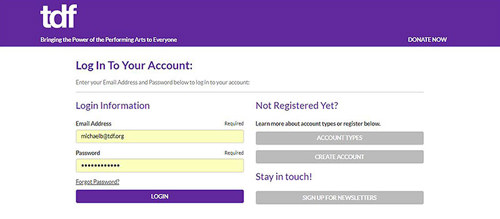
- Log in to browse current ticket offers.
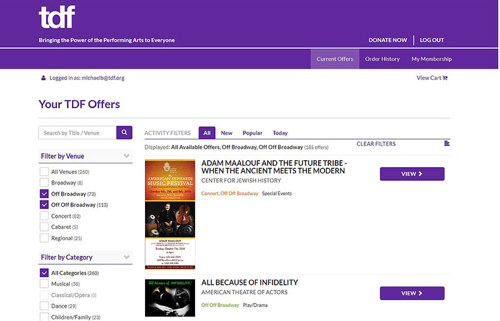
- Filter by venue, category, date, keyword and more. Click on a show for more information along with available dates and times.
- Choose your desired performance and number of tickets (up to 9 per performance), then click the Purchase button to add them to your cart. At that point, you can check out or continue shopping.
- When checking out, please REVIEW THE DETAILS OF YOUR PURCHASE CAREFULLY. All orders are final, refunds and exchanges are not allowed, so be sure to verify the tickets are for the performance, date and time you want.
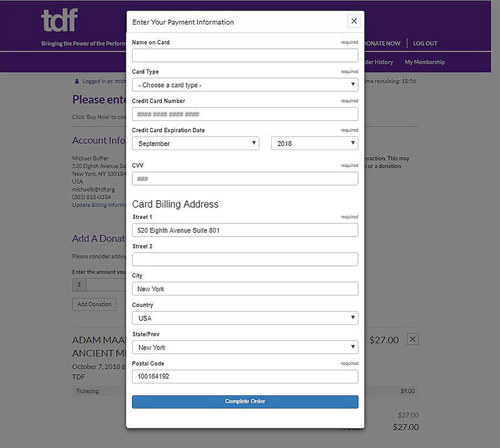
- Enter your credit card number (Visa, Mastercard or American Express), expiration date and CVV number. Verify your billing address.
- The final page is your confirmation and receipt, which will also be emailed to you.
All TDF tickets are held at the box office for pickup within an hour of showtime. The box office may ask you to present your order confirmation and/or a photo ID.
Up to nine (9) tickets per performance (subject to availability).
No, all TDF Member tickets must be purchased online.
Sorry, orders cannot be changed or canceled once processed. All orders are final and there are no exchanges or refunds. Please understand that TDF is not responsible for cast changes or inclement weather and cannot refund in such situations. Refunds are only issued if a performance is canceled.
No. TDF is unable to accept cash. If you want to buy tickets in cash, you can go to a TKTS Discount Booth or directly to the theatre box office.
Tickets can be purchased for any performance available. Sometimes we have tickets months in advance, but often they are within a week or two of the performance. Ticket inventory changes frequently. If you see a performance you want to attend, we recommend purchasing tickets ASAP.
The list of current offerings changes instantly throughout the day. Log in regularly to check for new performances and dates – shows can sell out quickly!
Any tickets you add to your cart are held for 30 minutes. If you do not purchase the tickets by then, they are released.
Login Issues
Translation: The email address you submitted could not be found.
Are you absolutely sure that you have correctly input your email address?
It may sound silly, but 90% of our users who complain that they can’t logon have simply made a typographical error in inputting their email address.
Are you using an “auto-complete” feature? If you are accustomed to inputting only the first few letters of your email address, your computer may have “remembered” a past mistake. Take the time to enter your email address and password completely, without using this feature. Once you have successfully logged on once, the “auto-complete” feature on your computer will “remember” the correct information and have it available for you in the future.
Did you change your password? Check your email for a message with the next steps.
Are you using an “auto-complete” feature?
If you are accustomed to inputting only the first few letters of your email address, your computer may have “remembered” a past mistake. Take the time to enter your email address and password completely, without using this feature. Once you have successfully logged on once, the “auto-complete” feature on your computer will “remember” the correct information and have it available for you in the future.
Did you change your password?
Check your email for a message with the next steps.
Our network didn’t recognize you!
If you can successfully logon, but return to the logon page when you attempt to view our current online offers, you probably don’t have “cookies” enabled in your browser. “Cookies” are little bits of data that are sent to your browser in order to securely identify you as you move about our website. Normally, your browser will forward this information back to our server each time you make a request. “Cookies” do not contain any private information, and are used only to securely and safely identify your account. In most cases, “cookies” are enabled by default.
To enable “cookies”, follow the instructions below for your specific internet browser. On some platforms, the location of your cookie settings may differ. Please see your browser specific documentation/help for additional assistance.
Microsoft’s Internet Explorer 6.0 and higher
- Open Internet Explorer and click Tools from the menu and select Internet Options.
- Open the Privacy tab.
- Click the Advanced button.
- Check Override automatic cookie handling.
- Set First-Party Cookies to Accept.
- Set Third-Party Cookies to Accept.
- Click OK.
- Click OK, again.
Google Chrome
- Click the wrench icon on the browser toolbar.
- Click Settings.
- Click Show advanced settings.
- Under Privacy, click the Content settings button.
- Under Cookies, confirm that Allow local data to be set is checked.
- Click OK.
Mozilla Firefox
- Click Options in the Tools menu, located on the menu bar.
- Click the Privacy tab.
- Confirm that the Accept cookies from sites option is checked.
- Click OK.
Safari
- Select and open Preferences from the menu.
- Open the Security tab.
- Confirm that the Accept cookies from sites you navigate to option is checked.
- Click OK.
For your security, TDF highly suggests that you upgrade your browser to the most recent version of your preferred browser software. However, if you are unable to upgrade your software, follow the instructions below to enable “cookies” on your browser. Please note that some features of TDF’s Online Offers may not be available to you. For assistance in upgrading, please contact your Internet Service Provider.
Translation: there is a compatibility issue.
TDF has discovered a compatibility problem with AOL for Broadband for the Macintosh. This is the only browser affected by this incompatibility. If you are experiencing this problem, please use the most recent version of Microsoft’s Internet Explorer for the Macintosh, or Safari.
If you are using an alternate browser, but experience a similar problem, please report this issue to TDF’s Technical Support Team.
Seating
Although we make every effort to seat people together, the box office sometimes sends us an odd collection of tickets that are not side by side. We cannot guarantee that seats will always be together.
TDF regrets that we are unable to accommodate seating requests. If you have a disability which requires seating consideration, you may be eligible for one of our TDF Accessibility Programs.
Our discounted tickets are always offered for seating anywhere in the theatre (unless specifically noted otherwise). Because we do not know in advance what seat locations we will receive for any given performance we cannot provide the location of your seats until you pick up your tickets from the box office on the date of the performance. Since our discounted tickets are always offered for seating anywhere in the theatre, we cannot honor any requests for special seating. Please bear in mind that many theatres have a mezzanine or balcony but no elevator. Exchanges at the theatre for different locations (downstairs, on the aisle, in the center, etc.) are simply not possible; the box office and house staff will not accommodate such requests. If you are unable to negotiate stairs, our TDF Accessibility Programs (TAP) membership is designed to accommodate patrons with disabilities. Tickets purchased through TAP are always downstairs and relatively close to the stage. These tickets are approximately twice the cost of tickets purchased through individual membership.
Ticketing
The price noted on your ticket will not always match the amount you paid to TDF. In addition to the $4 processing fee on each order, TDF includes a small service fee ($1-$5.50) in each ticket price to help fund our many education and accessibility programs.
Tickets purchased online may be picked up at the theatre 30 minutes before curtain time on the day of the performance only. Tickets may not be picked up at any other time.
Unfortunately no because each transaction is separate. You will receive a refund minus the $4 processing fee.
If we are informed in advance, yes, we will email all TDF ticket holders. Occasionally, a performance is canceled at the last minute. Either way, you will receive a refund minus the $4 processing fee.
Our $4 per order fee is nonrefundable because of incurred costs such as credit card processing fees and transaction expenses. Unfortunately, TDF does not receive reimbursement for these costs when a performance is canceled. As a nonprofit organization, our nominal $4 service fee allows us to continue offering affordable tickets to TDF Members. We aim to be as transparent as possible and we are grateful for your understanding and support of our mission to make the performing arts accessible to all.
At 8 a.m., Monday-Friday, online ticket sales end for that day. At 9 a.m. on Saturdays, all online tickets sales end for that weekend. Occasionally, at the request of the producer of the event, we will list an event for a couple of hours longer but this is very infrequently.
- Once your order is submitted, it cannot be cancelled or changed.
- Depending on availability and performance type, users are permitted to order up to nine tickets per performance. After your order is submitted, you will not be able to purchase additional tickets to this performance. If available, additional tickets may be purchased from the box office at full-price.
- Handling fees are nonrefundable.
- Although TDF will attempt to notify its patrons via our website of performance changes or cancellations, TDF makes no guarantees regarding the timeliness, accuracy, or reliability of information posted on our website regarding such changes.
- If, for any reason, TDF is unable to process charges against your credit card, you will be responsible for all charges associated with this your order(s).
- These services are for TDF ticket buyers only, and theatres reserve the right to require a photo ID and/or proof of purchase before releasing a member’s tickets.
- Participation in TDF’s ticketing programs is contingent upon compliance with all policies set forth by TDF and the individual theatres.
- Tickets will NOT be released to non-TDF members and are NOT transferable.
- Late seating is always at the discretion of the theatre’s management.
- TDF is not responsible for cast changes or inclement weather and cannot refund in such situations. Refunds are only issued if a performance is cancelled.
Online Security
We are dedicated to the privacy of our customer’s information and employ 128-bit Secure Socket Layers (SSL) encryption. SSL is the industry standard and among the best software available to ensure secure commerce transactions. SSL is used to encrypt all of your personal information. This includes your name, address and credit card number. The process of encryption converts your personal information into bits of code that can be securely transmitted over the Internet. You will know you are on a secure page when you see the following:
- The picture of the lock in your status bar
- https:// in the beginning of your address bar
Most newer browsers are capable of supporting the SSL protocol and will automatically detect the presence of this protocol and convert to secure mode, which is indicated by the presence of either an unbroken yellow key or a closed yellow lock in the browser’s status bar. Please note that older browsers do not support 128-bit SSL encryption, and therefore cannot be used to purchase tickets online through TDF.
Website and Technical
If you are having trouble accessing the TDF website, please email the following information to info@tdf.org: What type of computer are you using? What operating system? What browser? What version? What exactly is happening and when? If you are reporting a broken link, where is it and what is it linking to? What exactly did the error message you received say? I cannot remember my password. How do I retrieve it? You can easily reset your password on the TDF log in page by clicking “Forgot Password.”
The newest version of the following browsers have all been tested with our website.
- Google Chrome
- Microsoft Edge
- Firefox
- Safari
We encourage everyone to use the newest version for optimal security (upgrades are free). To Find Out the Version of Your Web Browser In the browser, click on “Help ->About ->.” The browser version will be listed.
To Clear Your AOL 9.0 Browser Cache From the horizontal toolbar at the top of your screen, click on “Settings.” A box appears called “Settings: Essentials.” Click on “Internet [Web] Options.” A new window will launch called “AOL Internet Properties.” Click on the “General” tab. Under “Temporary Internet Files” click on the “Settings” button. On the “Settings” page, make sure “Every visit to the page” is selected. Click “OK.” When you return to the ‘”General” tab, click on “Delete Files” to clear the cache. Click “OK.”
To Clear Your Internet Explorer Cache (Windows) In the browser, click “Tools” on the menu bar. Choose “Internet Options.” On the “General” tab, click “Clear History.” When it asks “Delete all items in your History folder?” click “OK.”
To Clear Your Internet Explorer Cache (Mac OS X) Open the Explorer menu and select “Preferences.” Find the section labeled “Web Browser” and click on “Advanced.” Find the section labeled “Cache” and click on the “Empty Now” button.
To Clear Your Netscape Cache Launch Netscape. In the browser, click “Edit” on the menu bar. Choose “Preferences.” Click on the plus sign (+) by “Advanced” and choose “Cache.” Click “Clear Memory Cache” and then click “OK.” Click “Clear Disk Cache” and then click “OK.” Click “OK.”
To Clear Your Mozilla Firefox Cache (Windows) In the browser, click “Tools” on the menu bar. Choose “Options. Select “Privacy.” Choose “Cache.” Choose “Clear.”
To Clear Your Mozilla Firefox Cache (Mac OS X) Open the Firefox menu and select “Preferences. Click on the “Privacy” tab. Find the line labeled “Cache” and click on the “Clear” button.
General
If you have tickets for a cancelled or closed show, TDF will automatically refund your money and credit your account (less the handling fee). When possible, we make every effort to process refunds prior to the cancelled or closing date of a performance. Always check your email for last minute updates.
The CVV (Credit Card Validation Value) number or security code is the three-digit number on the back of your MasterCard of Visa. On American Express cards, it is the four-digit number on the front of the card, just above the account number. This is an added safeguard against fraud.
For added security, the TDF website does not store credit card information. Please enter the account number of the credit card you wish to use each time you place an order. The date I would like to attend a show is not available. TDF is only able to offer discount tickets that each individual show makes available to us. The dates, times and quantities are sometimes very limited, and this can be reflected in what you see in TDF’s online offers. TDF always strives to offer the greatest range of performance times possible, and we encourage you to check back periodically for new dates and shows.
Most box offices require that you (the TDF member) be present, showing a matching photo ID along with your printed ticket order confirmation. If you need to view or reprint your TDF order confirmation, log in and click “My Orders.” Tickets may not be released to anyone except the member and only with proper corresponding identification.
The TKTS Discount Booths and TDF membership are two different programs. TDF membership is open only to eligible individuals and requires a $42 membership fee to join. TDF membership allows you to purchase tickets online at discount prices in advance. The TKTS Discount Booths offer same-day discounts on tickets to the public.
If you’ve read this entire page carefully and still need more clarification, please contact us by email at info@tdf.org. If you’ve purchased tickets, be sure to send us your full name, email address on file and the show about which you are inquiring.
You can easily reset your password on the TDF log in page by clicking “Forgot Password.”
If you are eligible, you can create a TDF membership account with the same email and password as your existing accessibility membership account. Please note, our TDF Membership Program does not provide accessibility services such as the ability to fill specific seating needs, open captions, audio description, ASL, etc. Contact tap@tdf.org if you have further questions.
When you log in, you will see TAP offers at the top and TDF member offers below. If you only want to see TAP offers or only want to see TDF member offers, click the filters on the left-hand rail.
If there’s a performance that you do not wish to buy, click the “X” button in your shopping cart to remove that order from your cart. How do I print a copy of my confirmation? You can access your online receipt for upcoming performances by logging in clicking “My Orders.” You can click on any order and print the confirmation page as your receipt.
To change your email address, please log in. Click “My Membership” from the menu bar and enter a new email address.
To update or change your billing and shipping address, please log in. Click “My Membership” from the menu bar and modify the address you wish to change.
If a member unsubscribes from our emails, by law we cannot add your email address back to our list. You may resubscribe to TDF e-newsletters here.
You may contact us via email at info@tdf.org or explore other ways to contact TDF.
Digital Membership Card from Cuseum
Yes! TDF has partnered with Cusuem to provide Digital Membership Cards to Members. Download the card to your smartphone wallet to enjoy Member Perks, an ever-growing list of deals and discounts from a variety of businesses. We will also be able to send you push notifications when hot new shows go on sale at TDF. This is all free with your active Membership.
Please follow the instructions in the email from Cuseum.
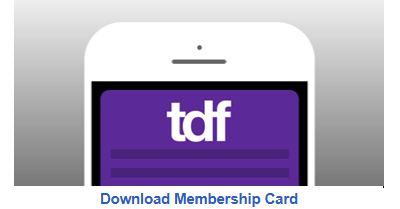
Please click the words “Download Membership Card.”
Please email us at info@tdf.org and we will make sure Cuseum resends the email. If you still don’t see it, please check your junk folder.
Of course! Downloading the Digital Membership Card is completely optional, but we highly recommend that you add it to your smartphone wallet so we can send push notifications about tickets, new Member Perks and renewal notices.
No, it’s just an added perk of TDF Membership.
Yes. The expiration date should correspond to the end of your current TDF Membership. When you renew, it should update. If not, please email us at info@tdf.org and include your TDF Member ID#.
No scanning needed! If you want to take advantage of our Member Perks, just present your Digital Membership Card for in-person offers or follow the instructions for online deals.
No. You are required to present a photo ID to pick up tickets.
Check out the Cuseum FAQ.
No FAQs match your search.
- TKTS Times Square – West 47th Street between Broadway and Seventh Avenue
- TKTS Lincoln Center – located in the David Rubenstein Atrium at 61 West 62nd Street
- Get TKTS Discount Booth hours and more information.
Look for one of our Patron Services Representatives wearing red TKTS shirts or jackets. They’ll be happy to help you and answer all your questions!
Yes. Both TKTS Discount Booths have the same offerings. Tickets are available up to 50% off the full price (plus a $7 per ticket service charge).
Yes! View a live feed of current ticket offers, or download the official TKTS app (available for all iOS and Android devices) for free.
Every ticket sold at the TKTS Discount Booths is discounted. Every day, each individual show chooses the discount percentage (50%, 40%, 30% and 20%). Since different shows have different ticket prices, the amount varies. Our live feed of current ticket offers and TKTS app include the price range for every show available.
TKTS has the lowest ticketing fees in the industry. Fees from TKTS support TDF and are used to offset the cost of operating the TKTS Booths and to support TDF’s arts education, access and community programs.
TKTS fee: There is a $7 per ticket service fee that goes to TDF. Facility fees: These fees, which can range from $1-$2.50 per ticket (depending on the theatre), are added on to the ticket price by the individual theatres.
Broadway League fee: Shows whose producers are members of Broadway’s trade association, The Broadway League, add a $2 per ticket Broadway League fee.
TKTS accepts cash, all major credit cards, TKTS gift certificates, and debit cards that bear the Visa or MasterCard logo on them. There is no additional fee to use a credit card at TKTS.
PLEASE NOTE: A small number of Off-Broadway shows may require cash only. TKTS no longer accepts Travelers Checks.
There is a limit of six tickets per person at TKTS, but if you need more, don’t worry! Just have more than one person with you, or speak with a Patron Services Representative, who will assist you in getting the seats.
Not necessarily. Although the bulk of tickets to go on sale are made available for TKTS by the time we open, shows may, and often do, release more tickets to TKTS throughout the day – right up to curtain time.
Seat locations change daily, and often throughout the day. When you get to the front of the line, the tickets seller’s computer will always retrieve the best available seats for the show. Which seating locations will be available for sale are determined by the shows themselves.
It depends on the show. When patrons who use wheelchairs arrive at the window, the ticket seller will call the box office for the show they want and see to inquire whether wheelchair locations are available. If so, the patrons may purchase the tickets at the Booth. Sometimes, after the tickets have been purchased, the patrons will have to pick-up the tickets at the theatre itself.
At this time, the only way to purchase tickets is to go to any of the two Booth locations and purchase tickets at the windows.
At TKTS Times Square, returning customers can use our Fast Pass lane to be fast-tracked to the front of the line. Just show your TKTS ticket stub or physical receipt to a TKTS Patron Services Representative. You can use the Fast Pass lane up to seven days from your original purchase.
The TKTS App
The TKTS app is the official TDF app which features accurate, up-to-the-minute listings, of all shows available at the world famous TKTS discount booths at all locations: Times Square and Lincoln Center. In the app, you may also find detailed and theatre information, TDF Stages Magazine, and more ways to interact with TDF.
You can download the TKTS app free of charge from the iTunes App Store, the Google Play store or the Amazon App Store.
Yes, every show available for sale is listed in the app.
The TKTS list reflects what’s on the TKTS boards in real time and, therefore, what’s for sale at the booths at any given moment. As ticket availability changes, shows will be added or removed from the boards. The TKTS app will also reflect all changes.
For technical support regarding the TKTS app, you may email TDF at app@tdf.org. If you have a TKTS booth related question, email us at info@tdf.org. You may also use the “Information” tab in the TKTS app to contact us.
If you would like to be notified when the show of your choice becomes available for sale at TKTS, you may add it to “My List” by touching the bell icon next to each show. You may be notified about as many shows as you would like and can manage these notifications from the “My List” tab. In order to be able to receive notifications, please make sure you’ve given the TKTS app permission to do so.
You can find the line wait times on the Map Screen which features the TKTS Booths’ location and hours. This can be accessed by tapping the pin on the right side of the top navigation bar (Next to the search icon!). To see the approximate line wait time at each booth, tap the booth on the map. A bubble will appear above the booth with an approximate wait time. If the booth is closed, the bubble will read “Closed;” if no time has been posted during open hours, it will simply read “Open.”
Please note that the stated time is an approximation in real time, and the actual line wait can fluctuate.
TKTS eGift Cards
TKTS eGift Cards can be purchased online at giftcards.tkts.com. They work like cash at both TKTS Discount Booths.
No. It’s digital only. But the upside is you won’t misplace it!
At this time, we cannot exchange upon request,* but you can still redeem your TKTS gift certificate at our NYC TKTS Booths.
*Due to an issue with our system, some past TKTS gift certificate buyers may receive an email about exchanging them. If you do, please follow the instructions.
Yes! You can redeem it in person at either TKTS Discount Booth.
No. We stopped selling TKTS gift certificates in December 2025.
Nope! You can use it at your convenience.
The difference must be paid in cash. You cannot split your transition between an eGift Card and a credit card.
Call 1-888-303-1175 and follow the prompts for automated assistance.
Nope! You can come back again and again until the balance is zero.
Just show the TKTS eGift Card email you received or give your 11-digit eGift Card number at a TKTS Discount Booth.
No FAQs match your search.
If you prefer to apply by mail, you can download our application here, and send a self-addressed, stamped envelope to:
TDF Accessibility Programs
ATTN: Application
520 Eighth Avenue, Suite 801
New York, NY 10018-5652
Yes! Please click here to add a TAP membership. If you need assistance, please email tap@tdf.org.
If someone in your household is already a general TDF member, that person can have a separate account even though your mailing address is the same. A separate email is required for log-in purposes and e-correspondence. Please remember that we do not know the seat locations in advance for any tickets ordered through general TDF membership. As a result, general TDF membership cannot honor any special seating requests. Therefore, if you plan to attend the theatre with your spouse/partner, we suggest that you order tickets through your TAP account.
The preferable proof of disability is a doctor’s note; however, a copy of an Access-A-Ride Pass, a copy of a disability parking permit or the results of a medical test (i.e. hearing/vision) are also acceptable.
You have 30 days from the day you apply online to send in your proof of disability.
If your condition changes (i.e., you now require an aisle seat rather than general orchestra seating), please call the TAP office at 212.912.9770 or email us at tap@tdf.org. When emailing, please include your customer ID#.
No, currently there is no annual fee for this service. However, a fee may be instituted in the future.
You can order up to nine (9) tickets per performance unless otherwise noted.
Yes, orchestra seating is guaranteed for all performances.
Yes, the tickets are more expensive because we guarantee orchestra seats for our TAP members. The cost of the tickets will be approximately 50% of the box office price for orchestra seats.
Yes, there is a $4 processing fee per order, per show (NOT PER TICKET). So, for example, if you ordered five (5) tickets for Hadestown, you would add $4 to the total cost of order.
All tickets through TDF are nonrefundable unless a performance is canceled. However, in some cases, you may be able to past-date your tickets for another performance by writing to tap@tdf.org. This is not a guarantee, it is at the discretion of the theatre.
Approximately every six weeks, an email will be sent with information about upcoming shows. Members who are hard of hearing or deaf will also receive emails about open captioned and sign language-interpreted performances. TAP members who are blind or have low vision will also receive emails about audio described performances.
Tickets will be held at the box office and must be picked up by the TAP member (photo ID required) within one hour of the performance. We only mail tickets for TDF Autism Friendly Performances.
We only mail tickets for our Autism Friendly Performances and we keep a record of all seat locations. If your tickets do not arrive, email autism@tdf.org and we can ask the box office to reprint them for pickup on the day of the performance.
Yes!
To order online from your computer:
- Go to the TDF website at tdf.org.
- Click on “TDF Login” on the top right.
- Type your email address where indicated.
- Type your password.
- Click “log in” and the page will open to the current offers.
- Click on the title of the show you wish to purchase tickets for and follow ordering instructions.
- Once tickets are ordered, you should receive an immediate confirmation of your purchase.
Your email may not be registered with your TAP membership or your account may be inactive. If you are having trouble, please email tap@tdf.org for further assistance.
TDF/TAP no longer sends out paper offers. All ticket purchases are done online.
Monday – Friday, 10 a.m. – 6 p.m.
TDF closes at 3 p.m. on Fridays in the summer (June 1-August 31).
Email: tap@tdf.org
Phone: Leave a message at 212.912.9770 and we’ll get back to you.
Mail: TDF Accessibility Programs
520 Eighth Avenue, Suite 801
New York, NY 10018
No FAQs match your search.
The TDF Broadway Passport Series is open to members of 65 organizations approved by the Empire State Development Corporation. Affiliation with one of these organizations is required to participate. As of fall 2025, the program is no longer accepting new members.
$20 Broadway Passport Series tickets may be located anywhere in the theatre, including on upper levels without elevator access.
$40 Broadway Passport Series tickets are for locations in the orchestra or front mezzanine of the theatre. The exact determination of the front mezzanine varies depending on the overall capacity of a venue. Please note that orchestra seats are never guaranteed.
No. Seating locations determined by the theatre are final and out of TDF’s control.
Sorry, orders cannot be changed or canceled once processed. All orders are final and there are no exchanges or refunds. Please understand that TDF is not responsible for cast changes or inclement weather and cannot refund in such situations. Refunds are only issued if a performance is canceled.
Members can order up to nine (9) tickets per performance (subject to availability).
If TDF is unable to process a charge to your credit card for any reason, you remain responsible for all fees associated with your order(s). Please make sure your payment information is up-to-date.
Most box offices ask for a photo ID that matches the name on the order. A printed ticket order confirmation is not sufficient. Tickets will only be released to the Broadway Passport Series Member.
Yes. Participating in our ticket programs means agreeing to comply with both TDF’s policies and the individual policies set by each theatre.
Late seating is always at the discretion of the theatre’s management. TDF has no control over this policy, so we encourage you to arrive on time.
You may contact us via email at info@tdf.org or explore other ways to contact TDF.
No FAQs match your search.
For the health and safety of our staff and customers, the TDF Costume Collection’s safety protocols are as follows:
- Appointments: All customers and visitors to the Costume Collection are now required to schedule an appointment at least 24 hours in advance. There are a limited number of slots per day and a maximum of two visitors per appointment. Names will be given to Kaufman Astoria Studios Security for admittance to the studio.
- Hours: Click here for current operating hours.
- PPE: Masks are optional in all Kaufman Astoria Studios common areas and within the Costume Collection. This policy is subject to change at the discretion of the Costume Collection staff.
For more information or to schedule an appointment, please contact us at ccreception@tdf.org or 212.989.5855. We look forward to working with you!
Any organization working on a theatre, film, dance, TV or other type of artistic endeavor is eligible to rent from our Costume Collection of 100,000-plus costume pieces. Not sure if your project qualifies? Email us.
Nope. But check out all the awesome things a TDF membership can do for your organization.
Care of Costumes
Absolutely. We just ask you include the name of the company or the rental number inside each return box.
Small alterations for size are acceptable, but you may not cut, dye or glue any garment. Small alterations may be kept in place, but large ones must be undone. Need more info? Email us and we’ll be happy to go over specifics.
Nope. If you do anything that permanently alters a garment, we will charge you the full replacement value.
We can lend you a rolling laundry hamper, but someone must come into the warehouse to get it. We cannot bring it to you.
Checkout
That’s when all of your selections must be made and prepped for our staff to inventory before you leave with the costumes.
It can take some time. Luckily, we’re located in a vibrant neighborhood, so feel free to run out to grab a bite to eat. We can call you when we’re done.
We can lend you a rolling laundry hamper that you can use in the freight elevator.
While we cannot ship same day, we can set up a future UPS shipment using our UPS number.
Just fill out this form. Please note that the shipping and handling charges are the renter’s responsibility.
Nope, sorry. We suggest bringing a helper with you if you’re dealing with a large number of items.
We generally bag costumes off hangers.
Misc
Job postings can be found on the Employment Opportunities page of TDF’s website.
We have biannual bag sales. To be notified about our next one, sign up for our email list.
Prices & Billing
Regular rentals start at $175 per costume, but if you are a not-for-profit organization, you qualify for a discount. Not-for-profit pricing starts at $75 per costume for a one-week rental. Dry-cleaning is mandatory and costs extra. Please see our price chart or email us for specifics.
Clients must prepay for post-rental dry-cleaning. For most items, the rate is $10 per pound. Items that require special handling (anything with suede, leather, fur, beads, sequins, etc.) are billed per piece. Don’t worry, once you’ve chosen your costumes, we can give you a dry-cleaning estimate at Final Checkout.
Cash, checks, or Visa, MasterCard and American Express. If you want to pay by purchase order, please email our administrator Taylor Alfano. Don’t have any of those? Call us at 212.989.5855 ext. 0 to see what we can work out.
Rentals must be paid in full before the costumes leave our warehouse.
You can exchange costumes as many times as needed. However, in the event that you don’t use everything you rent, we cannot offer a refund or credit. If you want multiple options to try on, you can take items on memo for an additional fee.
Pulling a Rental
Start by filling out our rental form. Not-for-profits get a discount upon proof of status, such as a 501c3.
Anyone willing to take financial responsibility for the project can fill out our rental paperwork. Email us to discuss specifics.
Yes! Most customers who visit our warehouse pick out their own pieces, though with 100,000-plus to choose from, it can be overwhelming. Don’t come here in a rush! Costumes are organized by time period or type, not size.
Yes! For an additional fee, our staff can assist you with pulling, sizing and anything else you need. Email us for information or to schedule an appointment with one of our staff designers.
Not-for-profits can pull costumes eight weeks prior to their first performance or shoot date. For regular rentals, customers can pull two weeks before the first performance or shoot date.
Your performers’ measurements plus any designs or photos. We have tape measures but we encourage you to bring your own. If you are pulling a large number of costumes, bring safety pins, a Sharpie and paper/oak tags to place on garments. You can even bring rack dividers to help you organize.
No. Unfortunately, due to COVID-19, costumes cannot be tried on in the warehouse. However, we have dress forms in multiple sizes available to our customers for fitting.
Yes! We offer affordable pulling services based on your needs. Call us at 212.989.5855 or email us for details.
Nope. But we have a vast collection, so there’s a good chance you can find something that fits.
Sorry, no. We suggest choosing a different item or, if your heart is set on it, repairing it yourself.
Returning Costumes
Anyone as long as a return appointment has been made for the organization and we have the name of the person dropping the items off.
Visiting Us
We’re inside the historic Kaufman Astoria Studios in Queens, NY, where lots of cool TV shows and movies are filmed. Visitors must obtain a studio pass at the guard gate and come in through the main entrance at the intersection of 35th Avenue and 36th Street in Astoria. See map.
If you need the freight entrance, it’s located across the street from a building called The Marx at 34-32 35th Street between 34th and 35th Avenues. See map.
By appointment only. Click here for current operating hours.
The M/R Steinway Street stop. Visit the MTA’s site to plan your trip.
There is street parking in the neighborhood. There are a few privately owned lots in the area as well. See map.
No, we do not.
Yes, all visits to the Collection require an appointment. Once a rental form has been submitted, we will process the paperwork and send it back via email with the rental pricing. After that, you are free to schedule an appointment with us by phone or email.
No FAQs match your search.