
Hamilton
A TDF Autism Friendly Performance
See the most revolutionary musical on Broadway in a welcoming environment
1. Who is this show for?
This is a special performance for individuals on the autism spectrum, as well as people with other developmental or cognitive disabilities who may benefit, not for the general public.
2. When is the show?
- Sunday, May 31, 2026 at 1 p.m.
3. Where is the show?
Richard Rodgers Theatre
226 West 46th Street between Broadway and Eighth Avenue
New York City
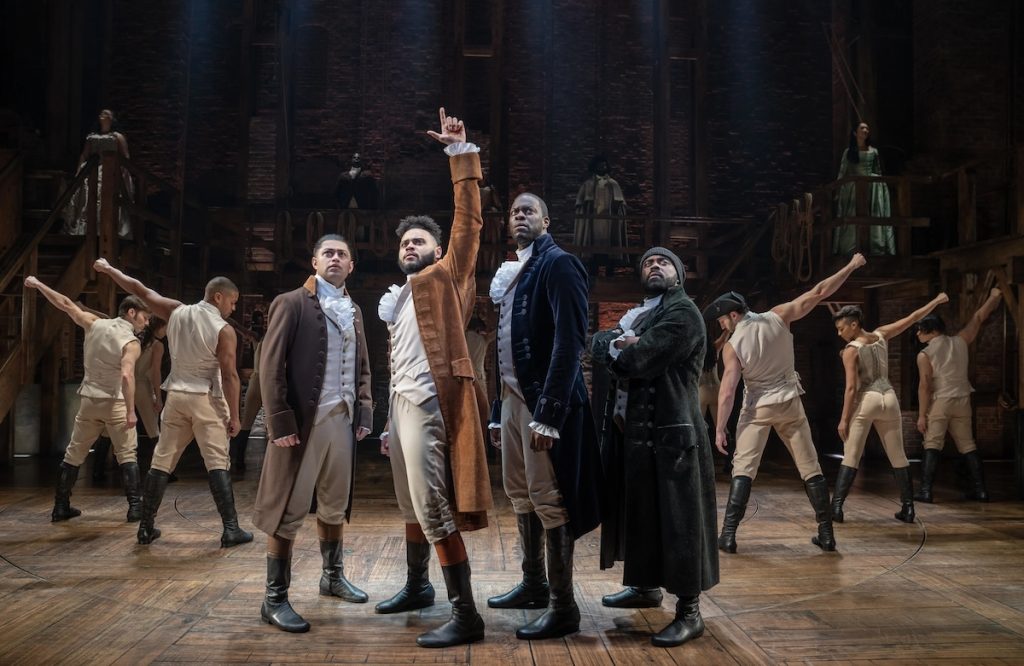
Hamilton on Broadway. Photo by Joan Marcus.
Ticket Prices
Orchestra: $65 – $79
Mezzanine: $65 – $79
Wheelchair accessible and companion seats: $45
TDF service fee: $2 per ticket
You need a TDF account to place a ticket order. If you do not have one, please fill out this form so we can create one for you.
Tickets for this performance are only available through TDF! Beware of secondary ticket sellers who may pretend to have seats at a much higher price.
About the show
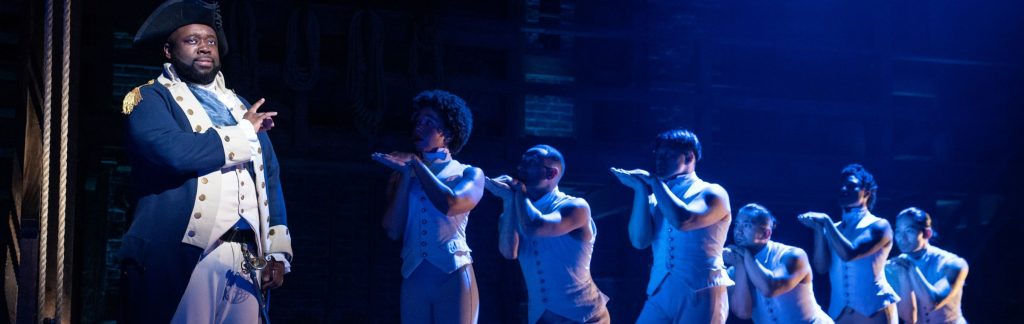
Hamilton is a musical that depicts the revolutionary rise and fall of Alexander Hamilton as he and his fellow American Founding Fathers help build a new nation. Using a blend of hip-hop, jazz, R&B and Broadway, this show reframes what is presented in history books and invites us to reconsider what we think we know about these individuals and how they are remembered.
Other information
Age recommendation: 10 and older. Children under 5 are not permitted in the theatre. Everyone must have a ticket.
Running time: 2 hours and 45 minutes including intermission
Resource Materials:
Peruse the Hamilton Logistics Guide
View the Hamilton Character Guide
Read the Hamilton Visual Narrative
Explore the Hamilton Picture Checklist
Accessibility: Orchestra rows A through K have the only seats accessible without steps. The theatre is not equipped with elevators or escalators. A wheelchair accessible restroom is located in the theatre’s main lobby at street level. Please note row CC is very close to the stage. We recommend using Seat View to determine the best seating for you and your party. Assistive listening and closed captioning devices are available.
Refunds are on a case-by-case basis up to 30 days before the performance. If you have an exceptional case such as COVID within 30 days of the performance, you must send proof of a positive test to autism@tdf.org for TDF to issue a refund. TDF is not responsible for cast changes or inclement weather and cannot refund in such situations. Refunds are only issued if a performance is canceled.
Content Warnings:
- Language: There is strong language, including profanity.
- Violence: Two characters are shot and die onstage. Violence in war is described, and an offstage suicide is referenced.
- Mature themes: Challenging topics are explored, including infidelity.
- Sensory: While lighting and sound adjustments will be made, this production includes the use of bright flashing lights in several scenes, as well as a loud beep to mute a curse word. Earplugs and a limited number of noise-cancelling headphones will be available. Please feel free to bring your own ear protection.
What makes the performance autism-friendly?
To create an autism-friendly event, the show is performed in a welcoming, supportive environment for individuals on the autism spectrum, with sensory sensitivities, communication challenges and/or learning disabilities. Slight adjustments to lighting and sound are made for the performance. There will be Break Areas staffed by specialists in the field in the mezzanine and downstairs theatre lobby in case any theatregoers need to leave their seats during the show. Downloadable resources, including a Visual Narrative with pictures of the theatre and the production, are available on this page.
We can make no assurances that this performance will be suitable for everyone with autism. Parents and guardians are solely responsible for their children’s viewing and engagement with the performance.
TDF wishes to acknowledge the following donors for their generous support of TDF Autism Friendly Performances:
Anonymous, Darlene and Stuart Altschuler, Theodore H. Barth Foundation, Sharon Chertok, The FAR Fund, Howard Gilman Foundation, Horace W. Goldsmith Foundation, Jane and In Seon Hwang, Morgan Stanley Soundview Complex, NEXT for AUTISM, Paul Hastings, Adolph and Ruth Schnurmacher Foundation, Seventh District Foundation, The Shubert Foundation, Sony Corporation of America, Standard Industries, The Start It! Foundation, The Taft Foundation, Ronald and Catherine Weiss in honor of Joseph Flom
This program is supported, in part, by public funds from the New York City Department of Cultural Affairs in partnership with the New York City Council’s Committee on Mental Health and Substance Use and the Committee on Disabilities. This program is made possible, in part, by the New York State Council on the Arts with the support of Governor Kathy Hochul and the New York State Legislature.