
Can AI Reinforce Our Humanity?

Theatre artists are exploring how artificial intelligence impacts us in ways both scary and surprising
—
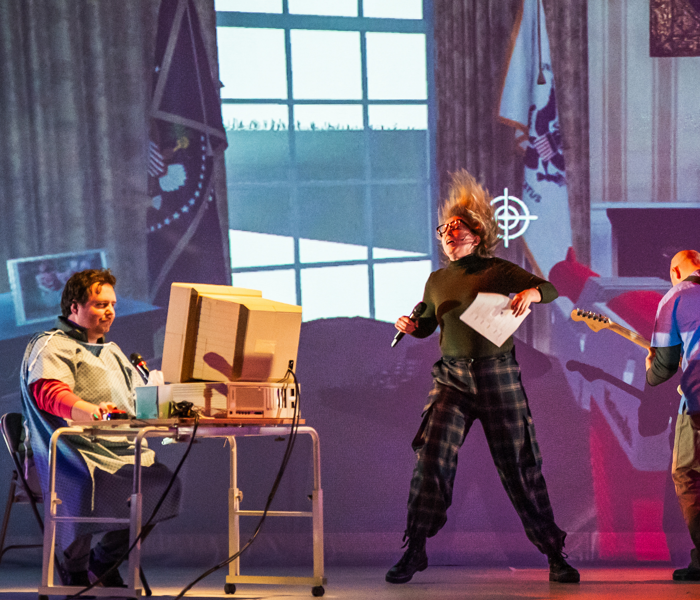
“You are not your data,” insists playwright Matthew Libby, who explores the cost of our unrestrained artificial intelligence boom in Data. Currently playing at Off Broadway’s Lucille Lortel Theatre, this timely tech thriller asks a question that’s top of mind these days: As AI-driven systems feeding on our digital footprints grow ever more powerful, do we risk reducing humanity to a set of data points?
Libby’s play, along with several innovative works at the annual Under the Radar (UTR) festival, are part of a wave of shows grappling with the impact of AI on all of us. Some of them even employ AI tools to critique the technology, sparking new ethical quandaries.
“Artists have such an important role in confronting AI,” says Matthew Niederhauser, the managing director of the tech-forward studio Onassis ONX, which is presenting some of the UTR shows. “If the work uses AI technology to create greater critical acuity of what is otherwise being spoon-fed to the public, that is a very important purpose right now.”
Data centers on Maneesh (Karan Brar), an ambitious programmer who faces a crisis of conscience when his algorithm is tapped for a massive surveillance project. For director Tyne Rafaeli, the core dilemma of Data is ageless: “What does a citizen, a human, do in the face of an increasingly oppressive and corrupt system?”
That “perennial question” has remained at the heart of the play, even as the concept of AI in criminal justice evolved from speculative fiction to disturbing reality—a shift Libby did not anticipate coming so quickly when he began writing Data in 2018.
“The moral questions have become more urgent and more complex as we face the consequences in a more immediate way,” Rafaeli says. “Which also makes for better drama.”
As AI advances exponentially, the technical minds of Silicon Valley “end up having to shoulder the burden of these philosophical questions that dictate our lives,” Libby notes. For the protagonist of Data that means reckoning with how his algorithm might categorize his own immigrant parents. “Ultimately, this play is a story of a guy returning home to himself,” says Libby. “To his own humanity.”
In the interactive work 2021, running at Brooklyn’s Mitu580 through January 17 as part of UTR, humanity itself is a program. All the data amassed by one individual over his lifetime is poured into another kind of system: an AI “grief-bot.”
“We’re not interested in AI as an intelligence on its own, but rather as an infrastructure,” says co-creator Cole Lewis, who developed 2021 with Patrick Blenkarn and Sam Ferguson. The piece was inspired by Lewis’ experiences navigating the broken bureaucracies of American health care while her father, Brian, was isolated in a hospital at the height of COVID-19. Now deceased, Brian the individual has become Brian the AI system—a painstaking recreation of his former self.
“When you die, all the stuff you leave behind can now go into this system that [will] reflect back some sort of statistical recreation of you,” says Ferguson, co-creator and lead programmer of the Brian-bot.
2021 begins as a video game that recreates Brian’s final weeks as a looping digital hospital. One audience member is asked to take the controls, “playing” as Brian while Lewis narrates live. Following Brian’s death, the piece shifts gears to a conversation between Lewis and the digital facsimile of her late father.
“It’s a limited technology to capture the fullness of a person,” admits Lewis. “And yet there have been moments when the AI will say something that surprises me, and I feel like I’m talking to my dad. What do we do with that? That’s scary.”
2021 explores many of the same themes as Jordan Harrison’s play Marjorie Prime, currently on Broadway courtesy of Second Stage Theater. But while the latter imagines AI recreations of deceased loved ones, 2021 actually conjures one to unsettling effect.
“How I, as a theatre artist, know how to deal with issues is to put them onstage and ask the questions,” says Ferguson. “Even though there are parts of what we’re doing that are unwise, the act of putting them onstage is how we learn.”
Lewis stressed that, at this point at least, AI cannot do the job without a human assist. “There’s a heavy dramaturgy to curating that data,” she says. “You have to shape it for complexity, or it will flatten more easily in AI.”

The solo show ¡Harken!, at Onassis ONX January 17 and 18 as part of UTR, probes AI’s limitations by examining historical inaccuracies perpetuated by the tech. When playwright Modesto “Flako” Jimenez was commissioned to pen a piece about Juan Rodriguez, an early 17th-century fur trader who was the first non-Native resident of Manhattan, he discovered much of the available scholarship was based on questionable accounts from white colonizers. All those inaccuracies, Jimenez noted, are now feeding directly into chatbots.
“If we didn’t do a good job with the stories that we have now,” wonders Jimenez, “what happens when we start trusting AI?”
In ¡Harken!, Jiminez performs as Rodriguez’s ghost. The mixed-race Creole man asks ChatGPT and other AI programs to share his history and is horrified by the answers. So Rodriguez enlists the audience to feed new information into the AI, hoping to correct the record.
“AI will argue it out with you and make you believe the fakeness,” notes Jimenez. “So why are we creating these tools? To reinforce our cute little fictions?”
¡Harken! exemplifies Onassis ONX’s goal of supporting work that does not blindly employ AI but uses art to “break the product,” as Niederhauser puts it. Similar issues are investigated in Graham Sack’s We Have No Need of Other Worlds (We Need Mirrors) at Onassis ONX January 9 to 12, and in the six digital installations that comprise TECHNE Homecoming, an exhibition that marks the opening of Onassis ONX’s new expanded home in Tribeca.
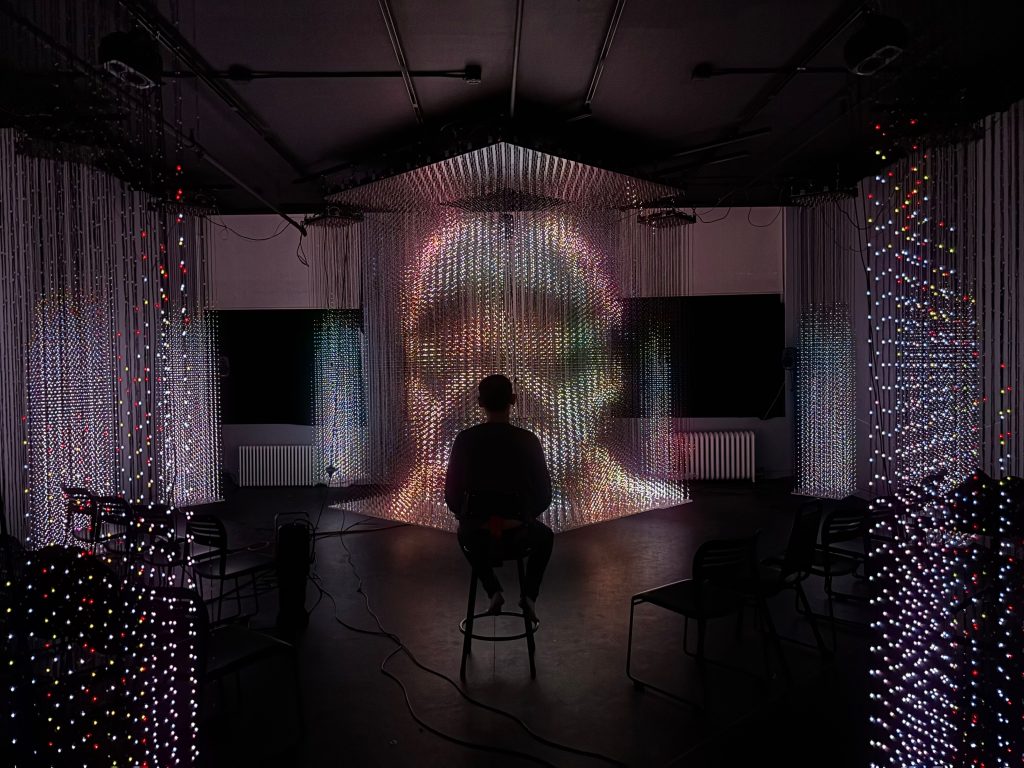
“Artists think in emancipatory and creative ways that provide alternatives to the way that technologies were created and originally designed to be utilized,” says Niederhauser. “Artists find the glitches.”
Still, as the story of Data warns, these ethical debates are far from settled, and the tech continues to advance more quickly than we can process its implications. What does that mean for humanity?
“Without even knowing that we’re doing it to ourselves, the human mind can lose all of its clarity around storytelling—around who gets to own our story,” says Jimenez. “There’s a real risk of becoming slaves to this technology.”
—
TDF MEMBERS: At press time, discount tickets were available for Data. Go here to browse our latest discounts for dance, theatre and concerts.