
Connecting the dots—the Benefits of Collaborative Set Design

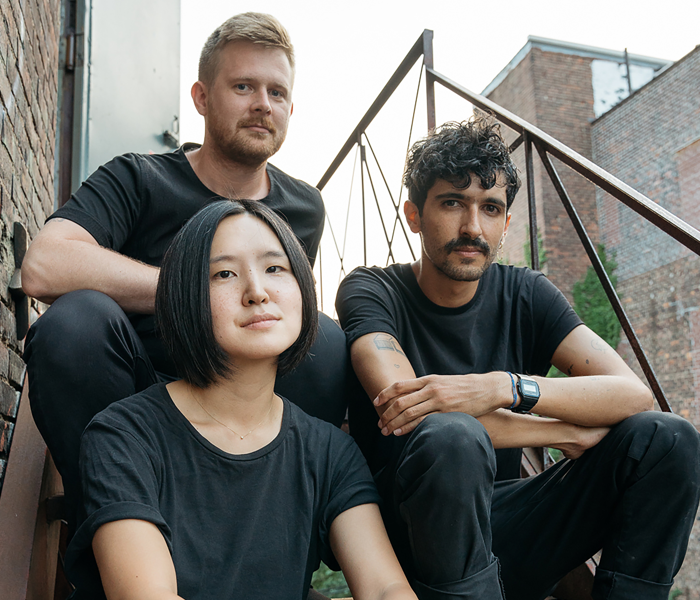
Why three scenic designers joined forces to become one sought-after collective
—
When the pandemic disrupted life, especially in the theatre, three set designers embarked on a remarkable collaboration that jump-started their careers post-shutdown. In 2020, Andrew Moerdyk, Kimie Nishikawa and Santiago Orjuela-Laverde, immigrants from South Africa, Japan and Colombia respectively, formed the NYC-based collective dots. The lowercase moniker, as per Moerdyk, signifies “how many individual dots/points/pixels come together to form a single beautiful image.”
Over the past three seasons, this trio has risen to prominence both on Broadway and beyond, earning three scenic design Tony Award nominations for incredibly diverse work: a decaying Arkansas plantation mansion for Appropriate, a minimalist evocation of an 1880s Norwegian home for Enemy of the People and the immersive punk-alien glamor of The Rocky Horror Show. They’re also behind the appropriately kitschy scenery for the campy Oh, Mary! along with a slew of shows on smaller stages.
TDF Stages chatted with the artists at their Park Slope, Brooklyn studio about how this venture grew out of a lockdown pod, the aesthetic benefits of being a collective and how their immigrant backgrounds bond them personally and professionally.
Gerard Raymond: It’s incredible that dots was born from a crisis.
Andrew Moerdyk: The pandemic created a moment of pause when all three of us, who were working independently before, suddenly became unemployed. Santi and I were in the same class at NYU grad school, and Kimie was a couple years ahead of us. We just ended up hanging out a lot and got to talking about the state of our lives and the industry—dreaming about how things could be a bit different and, ideally, better. Then we were like, why are we…
Santiago Orjuela-Laverde: …competing with each other when we can just work together?! We had similar training; the way we approach the design process—for theatre, film or whatever—is similar. We knew a lot of architecture offices had done this successfully: just get a name, create a logo and brand identity, and then work as a company. We use the metaphor of an umbrella that takes care of us.
Kimie Nishikawa: I always like to say that we weren’t necessarily friends but were very friendly. And then during the pandemic, we really became friends.
Gerard Raymond: How do you decide who does what?
Kimie Nishikawa: The boring answer is there isn’t a straight answer! There isn’t a rule. Coming from the same training definitely helps. There’s a vocabulary that we have in common.
Santiago Orjuela-Laverde: I feel each project asks for different methodologies from us. When we start a project, we try to conceptualize together and really understand the foundations. Eventually, when it gets into the details, somebody takes the lead depending on what the director prefers or on our schedules.
Andrew Moerdyk: What works so well is that we have a shared belief that we are not bringing a signature aesthetic to the table. We care very deeply about developing an aesthetic language that is specific to the task we’re doing. That’s the thing we’re very proud of: when you look at our work collectively, each project feels unique.
Gerard Raymond: What happens if one of you really doesn’t like something another person is doing? How do you handle disagreements?
Kimie Nishikawa: We talk it out. We make all the revisions in the model and look at it and discuss. Usually that resolves any disagreements.
Santiago Orjuela-Laverde: Also, we always remember we’re doing theatre. Whatever we’re doing together is bigger than each of our egos. It’s very easy, for the benefit of the project, to cease saying “that was my idea.” It doesn’t really matter.
Gerard Raymond: Does the person with the greatest passion for a project take the lead?
Kimie Nishikawa: No. It’s all about communication. Sometimes a production manager wants to know who to call first and then if that person can’t pick up for some reason, they have two other people to call. On some bigger shows, it’s clearly all-hands-on-deck. On The Rocky Horror Show, for instance, we were all there for the concept part. Then I think Andrew really took the lead, it meant so much to him. That happened organically.
Santiago Orjuela-Laverde: That’s a very good point because I feel like we also want to allow ourselves to be passionate about the artistry. If one of us has a very emotional connection to something, the process should allow for that.
Andrew Moerdyk: I have loved The Rocky Horror Show since before I was old enough to really love it! And it played a very formative role in who I am as a human. But I also think that if I had done that project by myself as Andrew, I would have been way more [cautious]. We made some really bold, wacky choices that I don’t think would have been possible had I not had people to ask, “Hey, is this an insane idea?” You can’t only rely on a director to do that because they are as invested in what you’re doing as they are in what 100 other people are doing. So when you’re like, “Can I stick toenails on this mannequin?” They don’t really care.
Santiago Orjuela-Laverde: I feel like for us, it’s very important that we recognize that we come from different places. We have different ways of seeing life—from Japan, Colombia and South Africa. We acknowledge that we have different points of view and that makes it very universal for us.
Andrew Moerdyk: Sam Pinkleton [director of The Rocky Horror Show and Oh, Mary!], said a lovely and really smart thing: that we create a continuous system of micro-editing just by virtue of being a group. It was really interesting to hear that perspective about how we work.
Gerard Raymond: How have your different backgrounds impacted your designs?
Kimie Nishikawa: I don’t think I see it in the aesthetic or the work necessarily, but I think the three of us have an open-mindedness that’s really important for every project. When I’m in New York, I sometimes have that gentle reminder that even though we’re from different parts of the world, we can still have the same sensibility. And that stems from the fact that we grew up in different places and came here.
Andrew Moerdyk: In a subconscious way, I think our foreigner status prompted us to do this in the first place. I never felt comfortable working under strict American individualist capitalism—and I say that with zero value judgment attached to it. I suspect all three of us kind of had that feeling and that we were like, why can’t we just make work in our own way: the sum of what I bring and you bring and you bring?
Gerard Raymond: You have done some very naturalistic work but sometimes you’re quite playful. Oh, Mary! comes to mind.
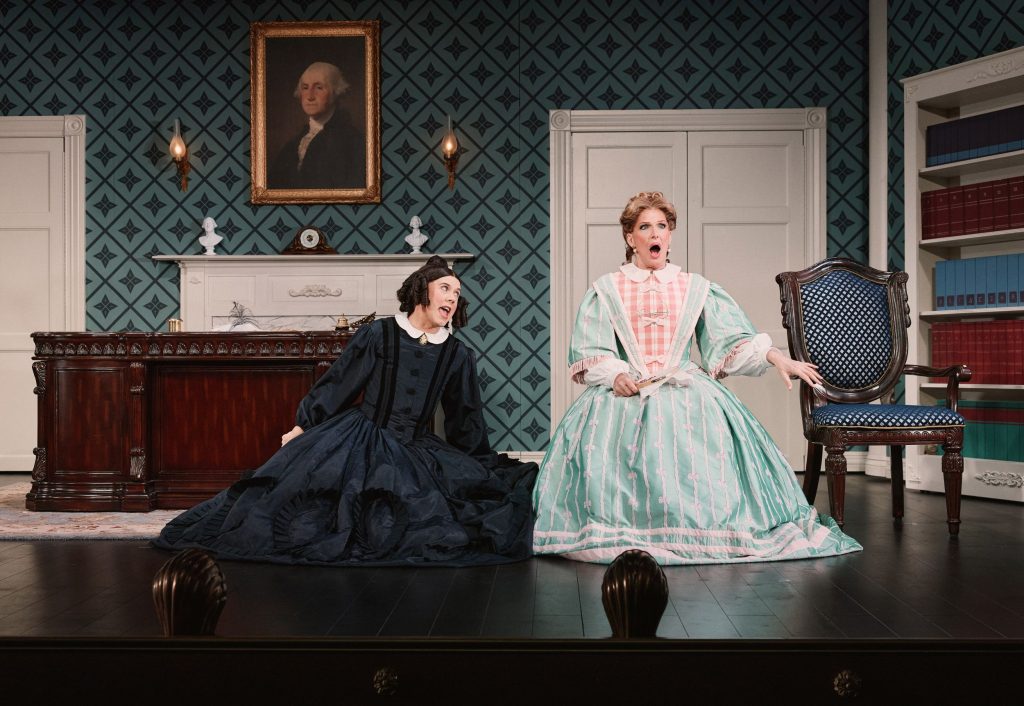
Andrew Moerdyk: Weirdly, even though Oh, Mary! looks totally dumb and invented, we looked at a bunch of regional 1860s plays. Obviously, what’s onstage isn’t that, but it’s definitely grounded in reality. Then we wondered, how do we make that funny? This is really a thing that came out of our training: it is always going to feel more compelling if you start from a place of something real.
Kimie Nishikawa: And then the finale, too, we looked at a lot of cabarets—there’s a bunch of Cher in there.
Andrew Moerdyk: There’s a thing that we straight up copied from Ethel Merman. A lot of that was just from understanding Cole [Escola]’s love of a Broadway diva.
Gerard Raymond: Looking back on your work so far, what has brought you the greatest joy?
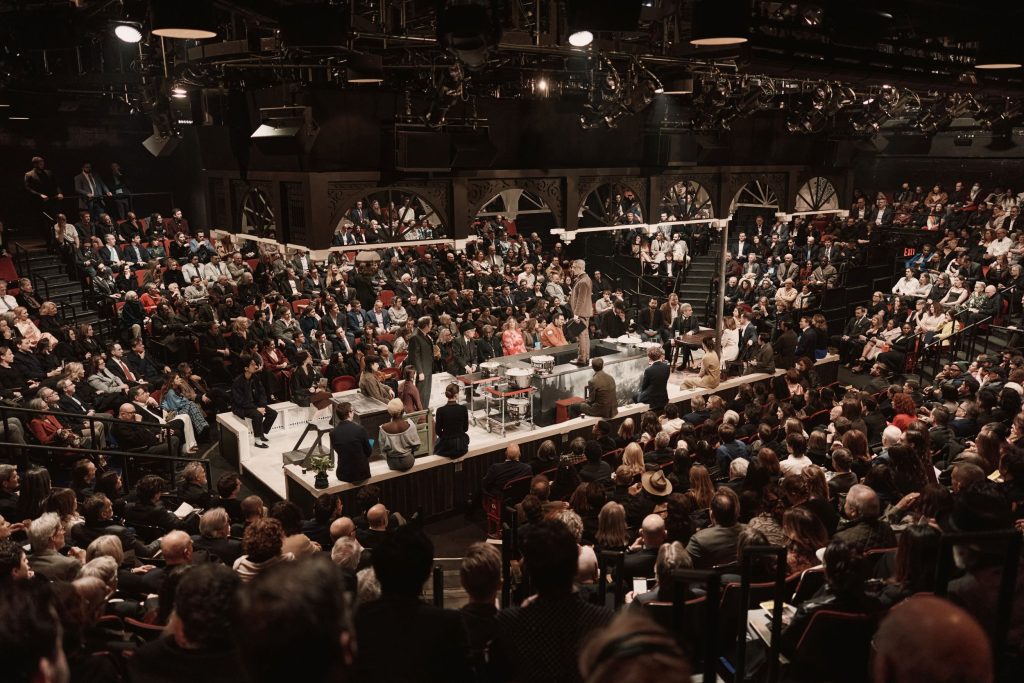
Santiago Orjuela-Laverde: For me, one memorable experience was seeing Enemy of the People in action at intermission [when a bar descended and the audience was invited to drink and mingle onstage]. We imagined it with Sam [Gold, the director] and when it was implemented at the Circle in the Square with an actual audience, it was so unpredictable.
Andrew Moerdyk: Obviously, The Rocky Horror Show brought me incredible joy, discovering people really loved the things that we approached with rigorous process. That’s such a thrill. Like Frank’s entrance in “Floorshow:” a total highlight was when people screamed and screamed for him coming down on this moon. We were like, of course it should be that moon because it used to be in Studio 54 [where the show is playing]. That’s the thing that brings us joy: when design results in a response.
Gerard Raymond: You’re doing scenic design for the world premiere of Anne Washburn’s Anon: a tempest at our kitchen table at MCC Theater, which starts in September. What can you say about working on this play about the scary traps embedded in a TikTok-obsessed society?
Andrew Moerdyk: I don’t think we’ve done a project with massive projections before.
Santiago Orjuela-Laverde: It’s very integrated with surfaces.
Kimie Nishikawa: We’ve had such great conversations with the full team. That’s been such a special part of the process for Anon. Because there is a lot of collaboration with the projection designer [Jared Mezzocchi], we can’t quite see what it’s going to look like in the model. In the first iteration, all the walls were at a straight angle and Jared asked, “Oh, can those walls be more on an angle, because then I can get a full shot of the walls?” We started to put an angle and the design ended up in a very different place. I think those kinds of technical limitations really made the design better in a way that we wouldn’t have been able to do ourselves. I can’t wait for us to actually get in the theatre.
Santiago Orjuela-Laverde: Also working with the writer in the room, that’s such a privilege. Being with Anne is so productive because in this specific piece the video component is inherently inside the story, the relationship with the screens and social media. I agree with Kimie, let’s see the video in action. Let’s see what it can do.
Andrew Moerdyk: If the story is about a new thing, I’m interested. Because I think curiosity is essential to this job. This looks like something we’ve never done ourselves before. And I think that’s always fulfilling.
This interview has been edited for length and clarity.
—
TDF MEMBERS: At press time, discount tickets were available for The Rocky Horror Show. Log in to buy tickets and browse all our offers.
Oh, Mary! and The Rocky Horror Show are frequently available at our TKTS Discount Booths.