
How Three New Plays Are Putting Sobriety in the Spotlight

The writers of Blackout Songs, The Dinosaurs and The Reservoir on the evolution of addiction onstage
Playwrights have been mining the drama of addiction for decades—Eugene O’Neill’s Long Day’s Journey Into Night, Tennessee Williams’ A Streetcar Named Desire and Edward Albee’s Who’s Afraid of Virginia Woolf to name some canonized classics. But this century has seen a steady increase in shows about the messy road to recovery. This month, three new Off-Broadway plays continue this deep dive into dependence with disparate takes on the fragile pursuit of sobriety.
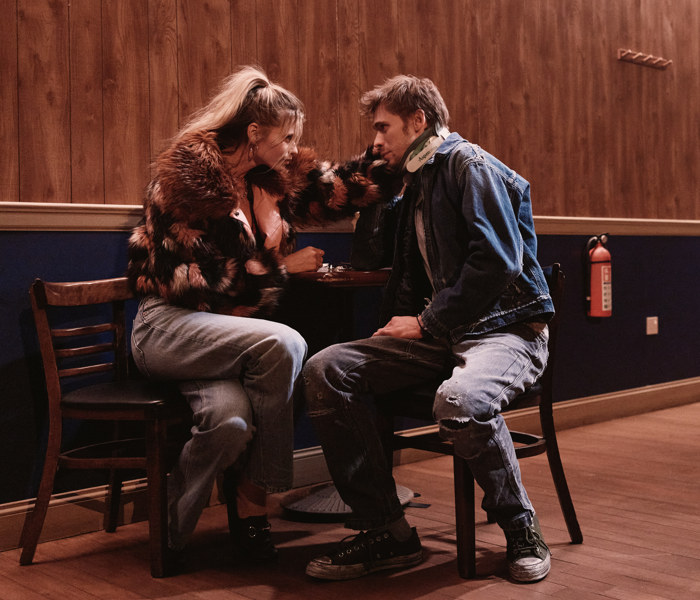
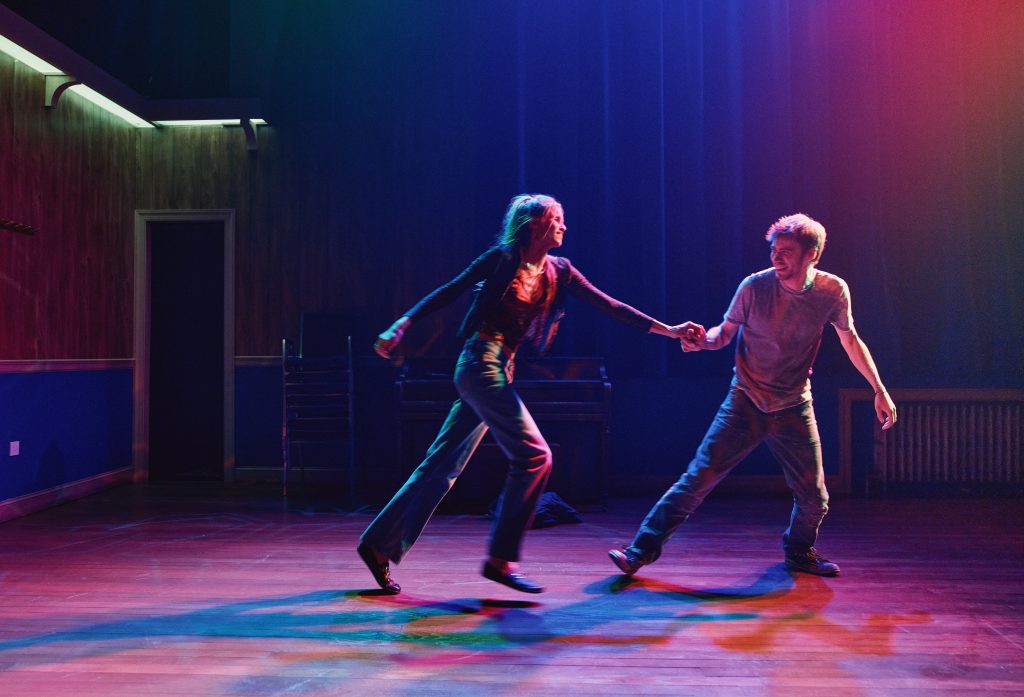
After earning an Oliver nomination in London, a new production of Joe White‘s harrowing Blackout Songs is playing Off Broadway through February 28. This intense two-hander follows a pair of alcoholics (screen actors Abbey Lee and Owen Teague) who connect at an AA meeting and begin a destructive romance. Trapped in a cycle of drinking, then drying out, then drinking again, they learn both addiction and love can intoxicate and distort reality.
In Jacob Perkins’ world premiere The Dinosaurs at Playwrights Horizons through March 8, a group of women (including Off-Broadway stalwarts April Matthis, Kathleen Chalfant and Elizabeth Marvel) gathers for a recovery meeting. Time moves strangely in this church basement, compressing and stretching as the world outside shifts, yet this collective keeps convening as they celebrate milestones, relapse and drift away only to return to the comfort of their community.
Jake Brasch‘s The Reservoir, making its New York debut at Atlantic Theater Company through March 22, centers on a young alcoholic theatre student (Noah Galvin) who returns to his childhood home hoping to rebuild his life with the support of his outspoken but ailing grandparents (Chip Zien, Caroline Aaron, Mary Beth Peil and Peter Maloney), who serve as an onstage chorus.
While wildly different, these pieces complement each other. All three are, in some senses, memory plays. They also aren’t brooding depictions of suffering addicts. Instead, they incorporate music and dark humor and reflect their writers’ varied paths to writing about recovery.
In 2020, Perkins had been sober for three months when he encountered a commission prompt from new play incubator Clubbed Thumb: “Consider The Decameron by Giovanni Boccaccio—but don’t write about the plague.” Perkins says his recovery journey helped him understand alcoholism as an “internal” plague and the support group as a circle of voices, like Boccaccio’s assemblage of storytellers.
Brasch is also sober, but they didn’t set out to pen a play about recovery. Instead, an Ensemble Studio Theatre/Alfred P. Sloan Foundation Science & Technology Project commission prompted them to focus on Alzheimer’s, drawing on their grandmother’s struggles with the disease. “I only came to understand that I was writing a recovery play when I realized that my own experience intersected with that world because I connected with my grandparents when I moved home to get sober,” they explained.
White also used memory as a starting point: His earliest ideas for Blackout Songs were suggested by Florian Zeller’s play The Father, which is told from the perspective of a character with dementia. Although he is not in recovery, White saw firsthand the damage alcohol can do. For three years, he lived with a friend who was grappling with addiction. After his roommate passed away, White found himself talking through the loss with mutual friends. “I couldn’t remember things and misplaced things and got things wrong,” he recalls. His friend “was so funny and artistic and musical, but he was wild and violently turned on people. I saw him do some things that were just unbelievable.”
Eventually, White began to see his slippery memories as part of a protection mechanism. “Your brain is helping you with trauma,” he explains. There was “this massive portion of my life that I’d forgotten or wanted to forget,” and he decided that was his way in.
There are intriguing overlaps between the productions. The Dinosaurs and The Reservoir both feature circles of chairs: a literal support group in the former, and a ring of grandparents in the latter. And The Dinosaurs and Blackout Songs are both staged in spaces meant to evoke church basements: the same room throughout in the former, but an empty container for a relationship gone off the rails in the latter.
Perkins says for him, none of these echoes are intentional. “I haven’t seen a play in like three years,” he explains. In 2023, just as The Dinosaurs received its second workshop, he learned he had cancer. He had already been considering abandoning the theatre industry, and his diagnosis prompted him to leave New York and enroll in a counseling program at Virginia Tech, where he is now in his final year. This production marks his unexpected return to the stage and he was happy to announce that he’s in remission at the first rehearsal.
His longtime friend and collaborator Keilly McQuail, who plays the most mysterious member of The Dinosaurs‘ clan, is glad he’s back. “We had not spoken in a long time when he wrote me to say the play was happening,” she says. “This piece came out of him going away. And I love that, because so often we spend years sort of asking the theatre to do its worst to us. It took Jacob going away and putting himself at the center of his own life for the work to come back.”
While all three playwrights acknowledge the shadow of addiction narratives by 20th-century greats, Brasch points out that alcoholism occupied a different space for that generation of dramatists. After all, Alcoholics Anonymous was only founded in 1935 and society’s understanding of addiction has evolved greatly since then. “O’Neill wouldn’t even have had the vocabulary to understand how to write a recovery play,” Brasch says.
Elizabeth Marvel is in a unique position to speak to how addiction plays have changed. Now in The Dinosaurs, she played Blanche DuBois in Ivo van Hove’s reimagining of A Streetcar Named Desire and Mary Tyrone in Robert O’Hara’s COVID-19 era adaptation of Long Day’s Journey Into Night. “The power of Long Day’s Journey Into Night is that it shows the nightmare of insanity: knowing what the outcome is going to be and repeating it over and over again anyway,” she says. “The Dinosaurs is the other side of that coin. Someone hits that point and then makes a different choice to open their hand and reach toward another human being instead of pulling in toward isolation.”
Tales of recovery seem particularly resonant at this scary and volatile moment—two other new Off-Broadway plays, The Monsters and The Unknown, also examine the impact of alcohol on relationships and the struggles of sobriety.
Brasch believes one reason these plays are all happening now is because they offer audiences “a path toward how to face a world that seems to be heading down a horrible path,” they say. “We can’t really imagine how this story ends. That’s where folks start recovery, with a sense of utter defeat, complete hopelessness, not believing in a world that could be safe for them. Yet folks around them are giving them the next right action. I think that’s an incredibly alluring space for folks to meditate inside of these days.”
—
TDF MEMBERS: At press time, discount tickets were available for Blackout Songs and The Dinosaurs. Go here to browse our latest discounts for dance, theatre and concerts.