
Playwright Jocelyn Bioh and Director Whitney White Are Back on Broadway Where They Belong
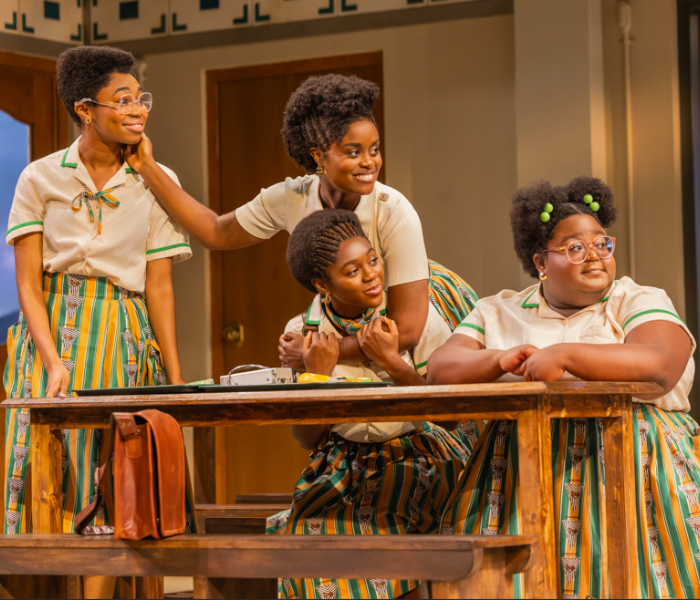
The Tony-nominated team behind Jaja’s African Hair Braiding reunites for a revival of School Girls
—
At a recent talkback, when asked, “What is a Broadway play?,” Jocelyn Bioh didn’t hesitate. “A Broadway play is any play that’s on Broadway.” It was the playwright’s no-nonsense way of saying that her show School Girls; Or, The African Mean Girls Play, a hit Off Broadway in 2017, definitely belongs on the Great White Way.
A biting, 1980s-set comedy about colorism directed by Whitney White, School Girls is receiving a top-notch revival at the Samuel J. Friedman Theatre courtesy of Manhattan Theatre Club (MTC), the same company that produced the duo’s inaugural collaboration Jaja’s African Hair Braiding back in 2023. Set in a Harlem hair salon run by West African immigrants, that crowd-pleaser was a triumph for Bioh and White, who both earned Tony nods, making it an auspicious double Broadway debut. (To clarify, it was Bioh’s Broadway debut as a playwright. She had previously appeared on Broadway as a performer in The Curious Incident of the Dog in the Night-Time and she’ll return to the Main Stem in School Girls for four performances October 9 to 11 to sub while a cast member is out.)
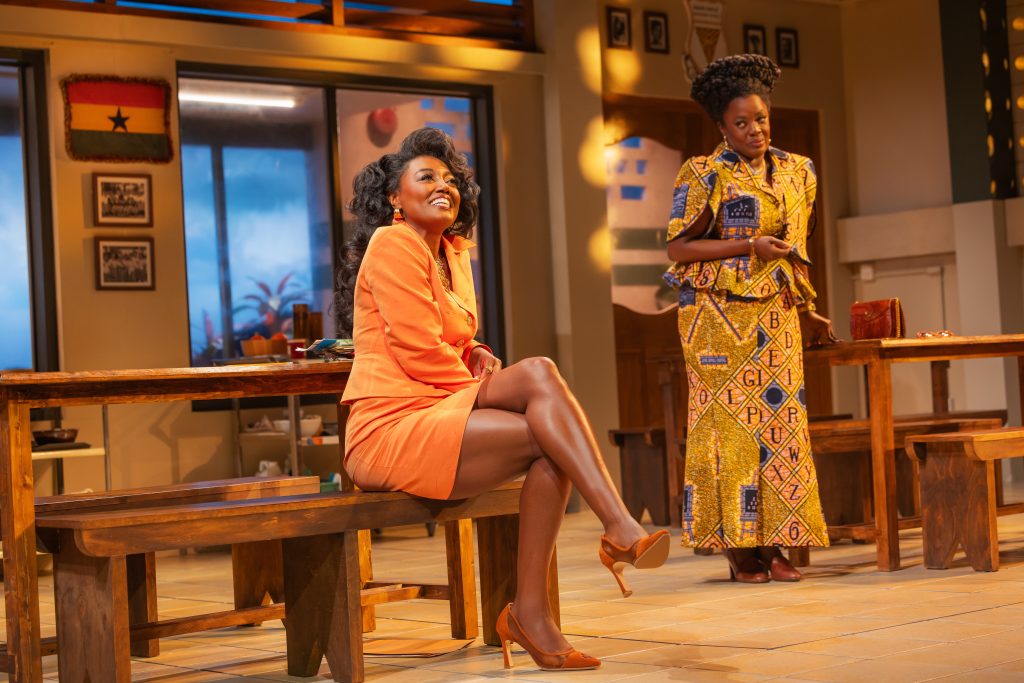
Since Jaja’s, White has seemingly been everywhere all at once: directing Bess Wohl’s Pulitzer Prize- and Tony-winning play Liberation, creating and starring in the rock musical Macbeth in Stride and preparing to helm Imitation of Life, John Legend and Lynn Nottage’s musical adaptation of the classic story at The Shed later this fall. But she wasn’t too busy to reteam with Bioh for School Girls, which follows a group of teenage girls at a boarding school in Ghana who are keen to compete in their nation’s beauty pageant. The starry cast includes Denée Benton as queen bee Paulina; Jasmine Amy Rogers as Ericka, an American transplant who upends the pecking order; Heather Alicia Simms as Headmistress Francis; and Pippin Tony winner Patina Miller as Eloise, an alum and former Miss Ghana now recruiting contestants. Bioh and White chatted with TDF Stages about reviving the show, their creative partnership and the joy of bringing their whole selves to Broadway.
Regina Robbins: First of all, Jocelyn, congratulations. It’s great that this play from a decade ago is getting its Broadway premiere in a production featuring a cast and creative team made up entirely of Black women. I imagine writing parts for Black women is one of your guiding principles considering you started out as a performer before becoming a playwright.
Jocelyn Bioh: Yeah, I think I share that same frustration with many [Black women actors] who started to write—Dominique Morisseau has mentioned this, Katori Hall‘s mentioned this—the lack of roles that really could fit who we were and show our artistry in full were limited. I never thought I was going to write large ensemble plays; I genuinely thought when I started writing that I was going to be a solo show artist. I loved Charlayne Woodard and Nilaja Sun and Sarah Jones and Anna Deavere Smith. Those were my heroes—they still are. So I thought that’s what I was going to do. All these years later, I have yet to write that solo show. I really fell in love with writing fun, challenging ensemble comedies.
Robbins: The American theatre ecosystem is looking for certain things from certain writers. Often writers of color are tasked with creating plays that check the “diverse” and “impactful” boxes. That’s why I think it’s so important that your primary mode is comedy. Was that your goal from the outset?
Bioh: No! When I got into Columbia’s MFA program for playwriting, I was like, okay, I’m going to learn how to be a playwright here. [At the time], my idea of plays was something very serious, brooding, kitchen-sink drama, family in turmoil. That’s what I was trying to write. Yet I found that when I sat down to do these exercises or write drafts of my very early, terrible grad school plays, they lived in a comedic space. But I was really trying to suppress it because I felt like a playwright writes serious plays. It wasn’t until years out of grad school that I was like, oh, I guess I’m just a comedic writer and need to embrace that. I think five years after I graduated was when I started writing what people now know my voice to be. My professors and my colleagues at school may be surprised to see that this is where I ended up.
Robbins: You’re unapologetically ambitious, just like Paulina in School Girls. How has that impacted your career so far?
Bioh: It’s so interesting to hear you describe it that way, because I don’t know that the work I’m doing feels super ambitious. It just feels super truthful to who I am and the stories that I want to tell—and maybe that is ambitious because I’m not conforming to the stories that people want to hear. Ultimately, where Paulina lives and where I hope I’m living is just rooted in telling the truth. Paulina’s delivery, her way of being, is not kind, but she’s not going to conform to what people want her to be. She does learn a very valuable and, unfortunately, heartbreaking lesson about what that means when you’re a Black woman, which I’ve experienced, too. Two of my plays have landed on Broadway, but that just speaks to the opportunity that MTC has given me. It’s not like they’ve been on Broadway at a bunch of different theatres; they’ve been on Broadway at this particular theatre. It’s almost like MTC is my Headmistress there: They’re allowing me the space and the opportunity to thrive and share my voice with audiences, and I’m really appreciative of that. But yeah, I think me and Paulina are rooted in wanting to be authentic and wanting to be true. Sometimes that can be thrilling and sometimes that can be devastating.
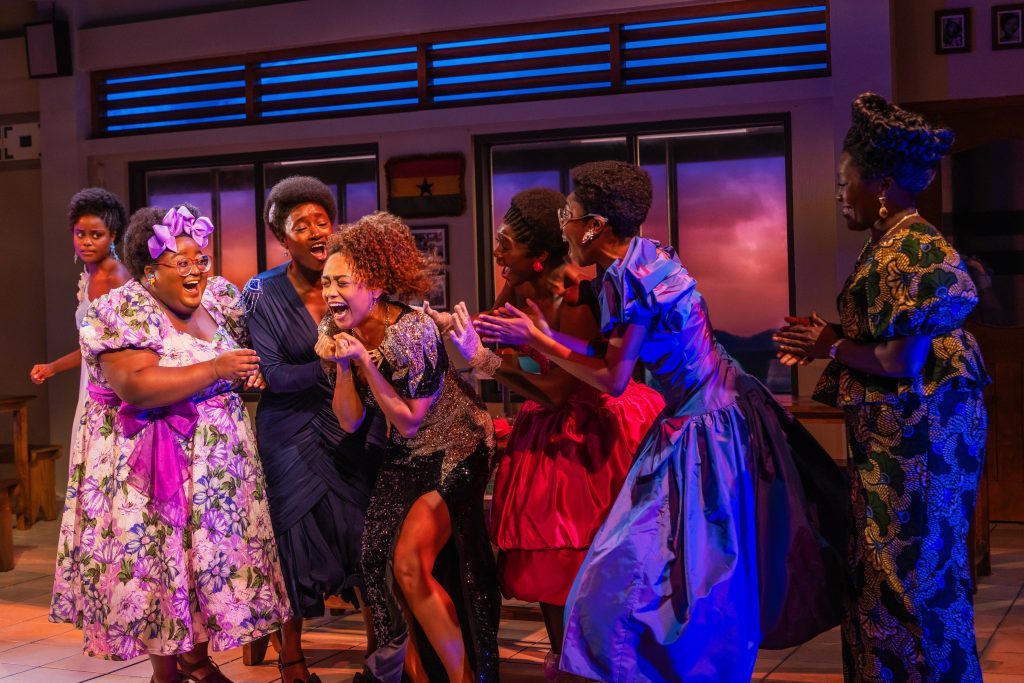
Robbins: My mother was a dark-skinned girl who grew up in the Jim Crow South, so School Girl‘s saga about bleaching cream was very familiar to me from her childhood stories. Even though the play is very specific to your own parents’ Ghanaian culture and history, it definitely speaks to folks across the diaspora. It’s exciting that MTC is giving this play its Broadway premiere so it can reach an even wider audience. How did this production come about?
Bioh: It really started when Whitney and I did Jaja’s together in 2023, which ended up being a real success for both of us. That was a huge risk for everybody, and we all stepped up to the challenge and had a great time working on that production. So MTC essentially was like, “What do you want to do next?” And I said, “Well, I’m approaching the 10-year [anniversary] of School Girls, and I’ve been thinking about doing a revival and would love to team up with Whitney to do it.” It was the easiest sell ever!
Whitney White: I have to salute Manhattan Theatre Club, because when we did our first reading of Jaja’s African Hair Braiding, we sat on [former artistic director Lynne Meadow’s] couch with Nicki [Hunter], who is now artistic director. And they said, “Where do you see this play?” It was our first collaboration, and we didn’t know each other that well. But we looked at each other and said, “Broadway, right?” That changed our lives. And now it’s not a question of whether a School Girls or a Jaja’s or—let’s just be frank—a mostly Black female ensemble piece about a particular diasporic experience of the world should be on Broadway. So, I am going to spill the tea: Nicki called us and was like, “Please, be my bride. Let’s get married and let’s start the season together.” That really doesn’t happen that often where the artistic director has the chutzpah and bravery to say, “Let’s do it again,” you know?
Robbins: A lot’s happened, culturally and politically speaking, since School Girls was first produced. We’ve had a global pandemic and some painful conversations about racism and representation. Do either of you see this play differently than you did a decade ago?
Bioh: If School Girls didn’t exist and I said, “I’m going to sit down now and write this play set in a Ghanaian boarding school about colorism,” I genuinely don’t know if I would be as honest, as raw, as real. Being in this business for quite some time, having worked professionally now for over a decade, there’s a censor I might put on myself about how honest I wanted to make these characters. And so I am really appreciating the writer that I was ten years ago. I was braver than I think I’d be now about telling this story in that way.
White: The very personal experience of value being attached to color hits me the same as the first time I saw the play. But what hits a lot differently now is Jocelyn’s brilliant look at socioeconomics. Jocelyn has scattered throughout the play a collection of symbols and images of the Western economy, like jokes about Nike or Calvin Klein. These things come up over and over again. The play has me thinking a lot more now about how the engine of commerce floods a country whether the barriers are up or down. Western countries’ products come in, and those products carry culture, and that culture carries politics, and those politics carry assumptions around value.
Robbins: Whitney, you have a background as a musical performer. I’m wondering how that impacted your work on this play, which is not a musical but has music infused into the story.
White: I think that everything is music. Things have a certain rhythm. Jocelyn hears it as well. My musical background really influences, for better or worse, my obsession with transitions and the way that things land. I’m driving people cuckoo right now over our first transition. They are so sick of me, because I can hear that it’s fine, but it’s not right. And we’ve got to get it right.
Robbins: Jocelyn, you’ll be stepping into the role of Eloise for a handful of performances while Patina Miller is away. Is she the School Girls character you feel closest to?
Bioh: I don’t think so. I think they’re all bits and bobs of me and how I feel or how I approach the world. Some days I have the confidence of Eloise. Some days I have the straight talk and energy of Paulina. Some days I just want to hang out and be cool like Nana. Or some days I want to take authority like Headmistress. They’re all facets of me in some way, but also of women that I know. I can write ten more versions of School Girls and still not be able to cover who us Black women are and how we are in the world.
White: I’m Gifty, hands down. I see myself so much in her, her random thoughts… it’s like I am Jocelyn’s walking, talking, breathing Gifty. You know what? I’m gonna take you down memory lane.
Bioh: Oh my god…
White: To Jocelyn’s performance in Everybody [in which she played the Usher in the 2017 Signature Theatre production of Branden Jacobs-Jenkins’ play]. I’ve been waking up with that a lot because I’ve been trying to motivate this cast to not only execute the play technically brilliantly, but to bring their audacity, their fire to it. And I remember how Jocelyn carried a whole room for 10, 20 minutes?
Bioh: Like a 20-minute monologue.
White: It was outrageous. I had Jocelyn in mind a lot when I was doing The Whoopi Monologues [earlier this year at Lincoln Center Theater], too. I’m working on bribing her into her own solo show. She just said she’s got more Black women characters to write. I want to see them. So you heard it here first: That’s what I’m working on.
Robbins: Maybe it’s a full-circle moment for you, Jocelyn, where your original conception of yourself as a solo artist comes to fruition.
Bioh: We’ll see. Never say never.
This interview has been edited for length and clarity.
—
School Girls; Or, The African Mean Girls Play is frequently available at our TKTS Discount Booths.
TDF MEMBERS: Log in to buy tickets and browse all our offers.