
Why an Autistic Playwright Is Ready to Cross the Line in His New Comedy

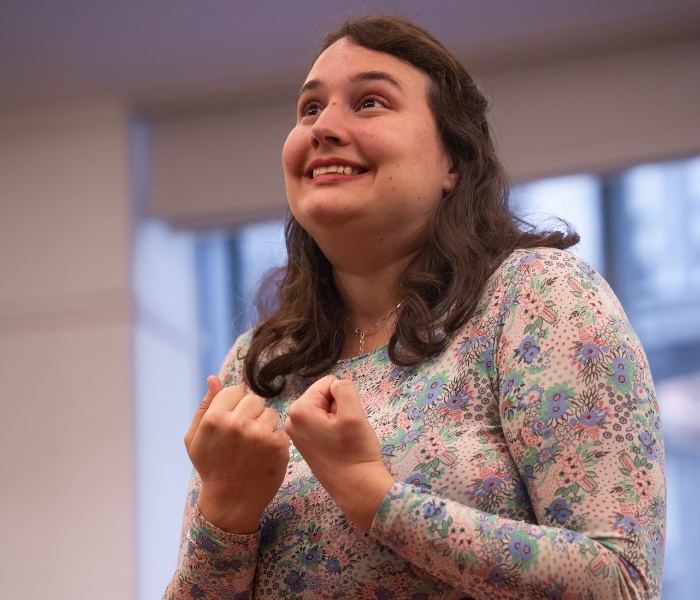
Dave Osmundsen on the origin of his new play BUM BUM (or, this farce has Autism), which is being produced by EPIC Players in December
—
My favorite feature of my Autism is my ability to view the world as a comedy. Communities bending to conform to rules whose origins are obscure; available folks trying their darndest to connect with unavailable ones; people disregarding social rules that the social skills classes of my youth sledgehammered into me—I find all of this hysterical.
But humor can be a strange (and painful) loop. It’s one thing for me to laugh at others’ lack of basic etiquette and self-awareness. It’s another when I inadvertently reveal my own lack of basic etiquette or self-awareness. Now others around me laugh and I’m the butt of the joke.
“We’re not laughing at you; we’re laughing with you!”
But what if I’m not laughing?
“Then you need to learn to laugh at yourself!”
I’m already hard on myself, why do I need to mock myself with laughter?
“Oh, come on! Don’t you have a sense of humor, Dave?”
Only when I find something funny.
Making people laugh has always come easy to me one-on-one. Much of my humor stems from making caustic and extreme observations about mundane situations. But when it comes to making groups laugh, I’ve always struggled. I’ve lost count of how many times I’ve made a joke in front of my peers or colleagues and was met with a confused chorus of, “What?” Or been accused of “going too far” or “crossing the line.”
The social isolation of finding something hilarious that no one else does is not funny. That’s why I avoided writing an all-out comedy for years. I was always afraid of “crossing the line,” a nebulous concept that differs from person to person. No matter what I write, I’m going to cross the line for someone, so why bother at all?
(My Autistic penchant for misreading social cues, absence of impulse control and occasional lack of social context does not help matters.)
Then in December 2022, I saw a shoddily unfunny production of a well-known comedy during which my mind wandered and I wondered: What would an Autistic farce look like? What could the genre illuminate about how Autistic, Disabled and Neurodivergent folks are often packaged as pure, innocent, inspirational beings? What would happen if Autistic people were allowed to fight for their authentic self-expression, appropriateness be damned? What would the humor of disability and farce look like when fused? How many sex jokes could I throw in?
But most importantly: Would audiences get the joke, find it funny and laugh?
And would my mother be able to bring her church friends to see it? (Her question, not mine.)
—
Next month, the neuro-inclusive theatre company EPIC Players will present the world premiere of the play that came out of my reverie, BUM BUM (or, this farce has Autism), running December 4 to 14 at HERE. Set during a disorganized live telethon, it centers on three Autistic performers who are pressured to present sanitized versions of themselves and their acts. But when they rebel, chaos—and hopefully comedy—ensue.
I didn’t begin writing BUM BUM in earnest until May 2024. I had just lost my day job, and my dad was dying from pancreatic cancer. (He died peacefully, calmly and relieved he wouldn’t have to hear me workshopping any more BUM BUM jokes). For the sake of my mental health, I channeled all my angst, anger and grief into being funny.
By this point, I had been cultivating a relationship with EPIC (Empower, Perform, Include, Create) Players for a few years, serving as a writing instructor and play submissions advisor. Since its founding in 2016, the company has centered and supported Autistic and neurodiverse performers, insisting they are capable of the rigor of professional productions. I subconsciously wrote BUM BUM with EPIC in mind. But considering BUM BUM is a satire about a company whose name is an acronym that skewers how Autistic performance is diluted for the sake of mainstream palatability, I figured EPIC would be too offended to produce it.
What I underestimated was how much EPIC would get the play. In fact, artistic director Aubrie Therrien’s impulse was to lean into the meta nature of EPIC producing it. This told me right off the bat that she and her colleagues were in on the joke.
As production meetings, auditions and rehearsals progressed, Aubrie and her collaborators showed that they not only got what made BUM BUM funny—the ridiculousness of ableism—but also the deeper point of the play’s humor: That Autistic people shouldn’t need to go to farcical extremes to have their authentic voices heard.
In writing and rewriting BUM BUM as well as working with the artists, I’ve come to love the challenge of creating a comedy. How do you make a deep and resonant political statement while keeping the tone light without sacrificing empathy for the characters? The subjective nature of humor only makes this balance more tenuous. Comedy has the ability to unify and offer incisive observations of humanity. But when not everyone (or no one) gets the joke—or worse, misinterprets it—it’s easy for the message to get lost.
Not everyone involved shares the same sense of humor. For example, there have been disagreements, debates and discussions about a joke involving a certain pop star who made a widely derided movie musical involving Autism. Does it stand out too much? Does it hit too hard? Will enough audience members know who this person is and what she did?
That said, everyone on the team shares the view that Ableism is Ridiculous. That it is so embedded in society and media, real-world change is difficult to enact. That our political leaders seem more concerned with finding “a cure” for Autism rather than offering support for Autistic people and their care providers and families. That most theatre producers and gatekeepers haven’t realized that authentic Autistic representation is worth investing in.
Working with like-minded folks has encouraged me to go deeper, darker and weirder. During a phone call with Aubrie, we began discussing a stand-up routine a character performs in the play. “You told me you wanted to Oh, Mary! this,” she said. “So Oh, Mary! this!”
That encouragement gave me permission to be funny on my own terms. It implied trust in my writing and my sense of humor. It allowed me to cross the line, pull back, then recalibrate so that the line is almost crossed, but not quite. It’s made the challenge of creating a comedy fun, exciting and hilarious.
(With apologies to my mother, the Oh, Mary!-ing I’ve done means it may be too “over the line” for her church friends.)
For an Autistic playwright whose humor doesn’t always land with people, this process has shown me I can risk, then fail, then risk again, then fail again, then risk, then frickin’ crush it. I have the power to keep moving the line.
—
TDF MEMBERS: Go here to browse our latest discounts for dance, theatre and concerts.