
Why Danny Strong and Michael Mayer Were Game to Rework the Musical ‘Chess’

The Emmy-winning scribe and the Tony-winning director on overhauling the notoriously troubled cult favorite
—
There’s no chessboard in the new Broadway revisal of Chess, and that’s by design. In previous iterations of the troubled-but-beloved 1980s pop-rock musical featuring a score of earworms by ABBA’s Benny Andersson and Björn Ulvaeus, the stage was often painted to resemble a chessboard, or the ensemble was costumed as chess pieces. At the very least, the central champions—brash and unstable American Freddie Trumper and cool and unhappy Russian Anatoly Sergievsky—sat down at an actual chessboard during the tournament scenes. But for the extensively reworked production currently at the Imperial Theatre, director Michael Mayer decided to lose the board because the musical “is never just about chess.”
“There are chess pieces in the set design,” he concedes. “But if you look very carefully, there’re also missiles in those chess pieces.”
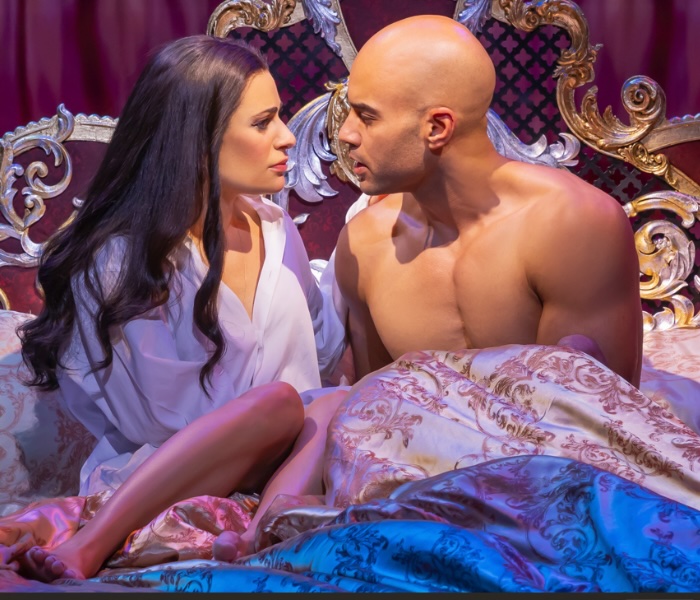
That’s because the stakes of this chess rivalry are intertwined with 20th-century Cold War politics as well as an explosive love triangle consisting of Freddie (Tony winner Aaron Tveit), Anatoly (Nicholas Christopher) and Florence Vassy (Lea Michele), the brilliant woman torn between them.
While that framework comes from the original show (conceived by Tim Rice, who also contributed to the lyrics), this Chess boasts a brand-new book by Emmy-winning TV writer Danny Strong (creator of Empire and Dopesick as well as a director and actor). Strong worked closely with Mayer to revamp this notoriously complicated musical and the duo found inspiration in an unlikely experimental form for a big commercial musical: epic theatre.
Most closely associated with German playwright Bertolt Brecht, this genre is highly stylized, political and metatheatrical. It presents a heightened reflection of society so, ideally, audiences experience an epiphany about their own existence.
“There’s a theatricality to the approach, and that was inherent in the concept of how I thought Chess should be redone,” explains Strong. “Theatricality, epic theatre, keeping the politics high up in the audience’s mind, and then using a narrator to solve story problems and take you through the piece. That was intertwined as one big idea of how to do this.”
Strong’s overhauled narrative is set against the backdrop of two real-life events: the SALT II treaty of 1979 and the Able Archer 83 military exercise, which both carried the threat of nuclear annihilation. “I knew that I wanted to infuse a Cold War historical event within each act to raise the stakes,” Strong explains. He delved into research, reading books and watching documentaries about the era. When Strong learned of Able Archer—”a moment in world history when a nuclear war almost happened because of a misunderstanding”—he says he had “a eureka moment” for the show.
Another significant change: Strong turned the preexisting character of the Arbiter into a narrator, cheekily played by Bryce Pinkham, whom Mayer calls “a uniquely gifted comedian.” In true Brechtian fashion, this character frequently breaks the fourth wall and the fourth dimension (aka time) to comment caustically on the action.
“When I saw how successful the character was [during developmental presentations], it made me really want to dive into a full-fledged epic theatre approach,” Strong says. “I thought it was going to be a light, sardonic wit, and instead the audience was so caught up in what he was doing.” This iteration of the Arbiter is loosely inspired by the Emcee in Cabaret, another musical with an epic theatre sensibility. (Fun fact: Strong played the Emcee in his high school production of that Kander and Ebb classic!)
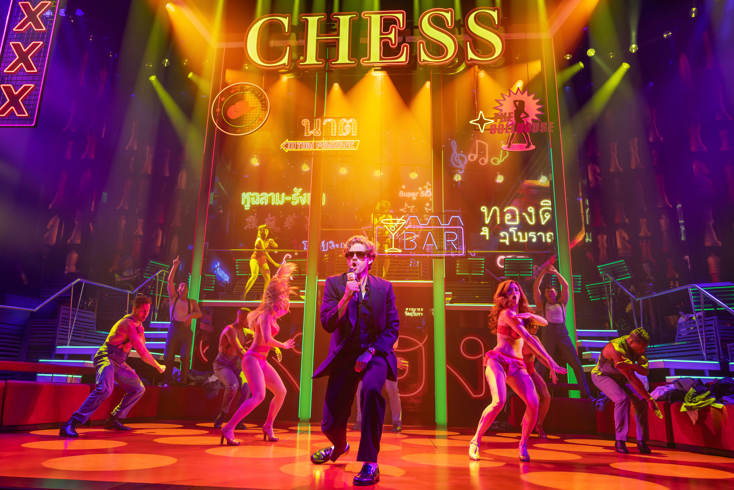
Given that Chess has been reimagined in various ways over the years, including as a sung-through operetta and a traditional musical, it makes sense that Strong and Mayer chose an unconventional approach to try to fix this famously problematic show. Despite its slew of bangers—including “One Night in Bangkok,” which became a mainstream hit—the original Broadway production ran for just two months in 1988. A particularly scathing review by Frank Rich for The New York Times asserted that Chess had the “theatrical consistency of quicksand.”
But Strong—a longtime fan of the score who never saw or read the script for the 1988 Broadway version—believed in the show’s potential from the get-go. “I think the whole concept is so cool: a fictional Bobby Fischer chess match that is a love triangle,” he says. “I wanted to do it not just because I love the songs, but because I love the idea of the show so much as well.”
It was actually Strong who put this project in motion. Initially, he set out on his own to see if he could find a way into the story but soon realized he wanted a collaborator in the endeavor. He was a fan of Mayer’s work, so he asked a mutual friend to reach out to the Tony-winning director to see if he was interested. The answer was an immediate yes.
“What excited me was his enthusiasm and the skill set he has demonstrated in his own writing, which is this delicious marriage of keen political insight and interpersonal drama,” says Mayer. “I felt like he innately understood how to strike a great balance between those two things.”
Strong also restructured the show to give Florence more of a central role in its politics and restored her solo “Someone Else’s Story” (long sung by Svetlana, Anatoly’s estranged wife) and made it the 11 o’clock number. His goal was to figure out “how Florence can exist in this show beyond part of a love triangle,” he says. “That’s why I was particularly open to the idea of giving her ‘Someone Else’s Story,'” a song he finds “much more emotionally resonant” as Florence’s final showstopper. “Those lyrics at the end of her journey feel powerful to me.”
According to Mayer, Michele was an active partner in the rehearsal room as they fleshed out Florence. “Lea was very generous with her ideas about how Florence could have agency, so that we really do understand that she’s the fulcrum of this story,” he says. “Florence is not actually a pawn. She’s a great chess strategist and we rely on her to give us a point of view about those two other chess champions.”
Mayer and Strong developed this production of Chess for nearly ten years before arriving on Broadway. The first public presentation was a semi-staged concert at The Kennedy Center in 2018. That was when they fully committed to the idea of the Arbiter as narrator. That mounting also revealed how relevant the show’s themes still feel despite the Cold War ending more than three decades ago.
“We were dealing with a Russia that colluded with Trump to destroy Hillary Clinton’s campaign,” Mayer says. “The idea that they could be influencing our free elections in America was a shocking thing.”
Not only does the Arbiter refer to the show as a Cold War musical, but he also suggests we might be in the middle of a new one. “What’s happening in our world right now is every bit as preposterous as the conceit that Danny came up with—that two chess tournaments could potentially have ramifications on real-life world politics,” Mayer says. And yet, these crazy days, anything seems possible, which is why Chess and its sardonic humor offer “a release that I think we all need.”
—
Chess is frequently available at our TKTS Discount Booths.
TDF MEMBERS: Go here to browse our latest discounts for dance, theatre and concerts.