
Why Longtime Collaborators Jon Robin Baitz and John Benjamin Hickey Are Working Together in a Whole New Way

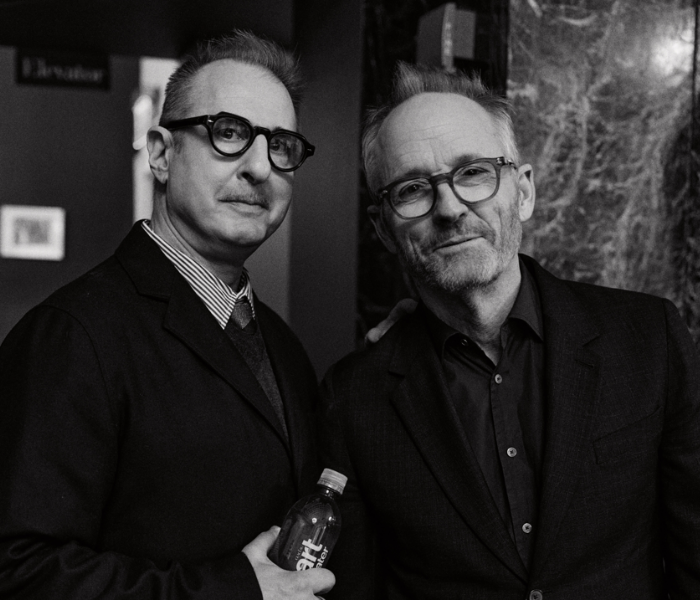
The playwright and actor-turned-director discuss their hit revival of Other Desert Cities
—
Perhaps it takes chosen family to compellingly conjure a dysfunctional biological one on stage. That’s what playwright Jon Robin Baitz and director John Benjamin Hickey (who are so close they interrupt each other’s sentences) are doing with the Broadway revival of Other Desert Cities, running at the Hudson Theatre through January 17, 2027.
Shortlisted for the Pulitzer Prize, Baitz’s 2011 play centers on Polly and Lyman Wyeth, a staunchly conservative, politically powerful couple in Palm Springs whose Democratic and depressive daughter drops a bombshell on Christmas Eve 2004: she’s publishing a tell-all memoir revealing the skeletons in their fashionable closet. Ideological arguments and explosive revelations ensue, yet despite their clashes, this is a family determined to talk through their differences—unlike so many loved ones on opposite sides today.
Because the production marks Julia Louis-Dreyfus’ highly anticipated Broadway debut in a tenacious turn as assimilated Jewish matriarch Polly, tickets prices are as shocking as the Wyeths’ secrets. (Tip: You can vie for $49 seats via lottery and rush and use this new website to gauge your chances of success.) She’s joined by Ed Harris as Lyman, a screen star turned Republican politico; Allison Janney as her acerbic, alcoholic sister Silda; Joe Keery as their slick TV producer son Trip; and Lily Rabe as the progeny with the problematic pen.
Baitz and Hickey, who is also a celebrated actor, have been collaborating since the early 1990s. But this is the first time Hickey has directed one of his pal’s plays. TDF Stages talked with the pair about how they met, the show’s enduring resonance and how Joe Mantello—Baitz’s former partner who directed the original production of Other Desert Cities—helped set this revival in motion.

Raven Snook: The two of you have been collaborators and friends for many decades. I even found pictures of you together at opening night of Other Desert Cities Off Broadway in 2011. How did you two first meet?
Jon Robin Baitz: John read for my play The End of the Day [which ran at Playwrights Horizons in 1992]. A mutual friend of ours, an actor named Geoffrey Nauffts who’s also a playwright, said, “This guy John Hickey is going to audition and he’s really brilliant.” And of course he was. I think you were just out of Juilliard at the time. You were also wearing a very impressive pair of shoes, which I’ve never forgotten, and I think that might have helped with casting. I remember the audition and the conversation like it was yesterday. We talked about The Dictionary of Cultural Literacy that had come out. You thought it was a terrible thing.
John Benjamin Hickey: Well, it was sort of fascist-y I thought. Telling people what they need to know about and what they don’t need to know about is always very dicey and arrogant.
Baitz: John was so good that he went straight from The End of the Day with Jean Smart, Roger Reese and Nancy Marchand to The Substance of Fire [an earlier Baitz play that had transferred from Playwrights Horizons to Lincoln Center Theater]. Along the way, he became part of our family.
Hickey: Love! Valour! Compassion! [by Terrence McNally] came not long after, and I met Joe [Mantello, the director and Baitz’s then partner] through that. So it’s a long-standing friendship and artistic relationship. I credit Robbie with giving me my career in New York theatre, which continues to this day.
Baitz: John got his own career in the theatre, but he’s always been an amazing person to me because he manages to balance his love of the theatre with the practicalities of having to make a living, which often involves television and film. It’s a great feat. I always tell young actors that the career you want is that of John Hickey. And I include transitioning to becoming a masterful director. He’s really remarkable. He’s directing a very difficult play, frankly, with granular intensity and also real discipline and an actor’s sensibility, which has been really wonderful. It was Joe Mantello’s idea that Hickey do a revival of this play.
Snook: That’s amazing considering he directed the original production!
Baitz: Joe has a very brilliant producorial eye about putting people together. John knows my work as well as anybody could—he’s done so much of it. So it seemed like a great way to do Other Desert Cities without having to build a relationship with a different director. John also wasn’t going to feel in any way ginger about doing a play of mine that Joe had done before. The fact that Joe had the idea that John should do it was a sort of imprimatur that gave both of us the confidence to go forward.
Snook: John, did you have any trepidation?
Hickey: To be honest, I was all in. My central idea was to find a way to present a different take on the Wyeth family than the original production because that was indelible. I loved it so much, but I haven’t been haunted by it because I was able to find a completely different group of people. It’s such a great family play that it can sustain and grow from different great actors sinking their creative chops into these parts.
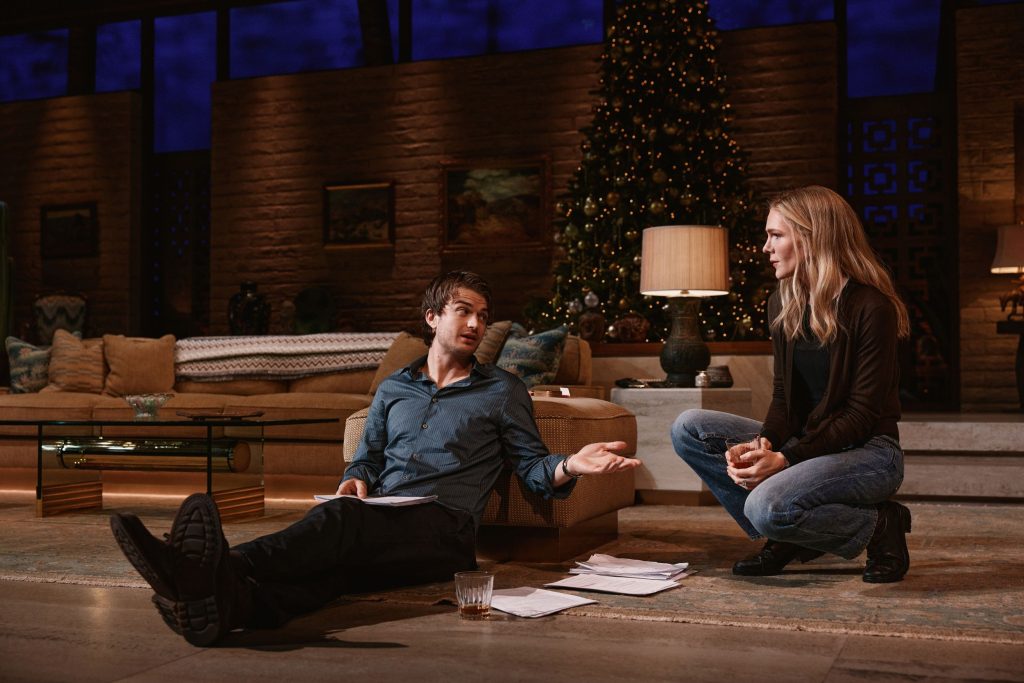
Baitz: John cast actors who are singularly unlike that original cast and show colors that are a different shade. It has a very different quality, and some of that is time as well.
Hickey: When I read the play again, I found it not only more relevant than ever, but actually deeper in its resonance about family and political divides.
Baitz: The political dynamic in the country, which is expressed in the play, is so much worse now than when I wrote it. There’s a battle going on in that house and John has managed to find a mirror to the alienation in the country between people who should be able to find love for each other. John has always acted from the heart, but his brain is just as fecund as his heart. So everything is rich and everything is examined.
Hickey: I’m happy I’m doing this interview!
Baitz: I’m happy you’re doing it, too.
Snook: Despite some ferocious exchanges, the Wyeths are civil and respectful to each other in a way that I worry we’ve lost.
Baitz: Don’t worry about it. It’s gone! That ship has sailed. We have people in Congress calling people dirtbags and assuming mendacity. The dialog doesn’t really work between parties anymore in the country. Meanwhile, as this absurd tit for tat goes on in Washington, DC, the value of people’s homes, the value of people’s dollars, their ability to provide for their families, the fundamentals of American life have been diminished so much. We’ve lost sight of what the country promised, and I think you see that in the play. The play might not resonate, actually, had we remained in civility and liberal effectiveness post-Obama. I think what we’ve found in doing the play is that the politics of it are philosophical. They aren’t overt, even though there’s discussion of what it means to be a conservative. But there’s a yearning in the play, I think, for the civility that attends wanting to actually know the other. The people in the play, however badly they’re doing it, are seeking common ground, and they stay in the room until they find it. I don’t think theatre should be medicine, but there is something kind of wonderful about watching people battle until they get somewhere that they can all breathe in again.
Hickey: And also—
Baitz: Let me just say one more thing, and then I’ll be sure to shut up.
Hickey: [laughing] You’re going to have to shut up!
Baitz: Yeah, I know I should. This play doesn’t actually take sides.
Hickey: That’s what I was just going to say.
Baitz: If anything, it argues that nobody knows everything about anything.
Snook: And that’s thanks to your writing as well as the incredible cast, a mix of stage veterans such as Ed Harris, Allison Janney and Lily Rabe alongside Joe Keery and Julia Louis-Dreyfus making their respective Broadway debuts.
Baitz: Julia was John’s brilliant idea, really, and it wouldn’t have occurred to me, even though I know her. I’m going to hand it over to John in a second. But I’m just going to say, I have 40 years in the theatre now. I’ve never seen a metamorphosis like what this woman does to herself to become Polly. Actors who are essentially comic actors, time and time again, turn out to be the most tragic actors as well. And John’s brought that out, and he earned her trust because of his experience. I think what she does is irrefutable because she’s so clearly Jewish in a way that Stockard [Channing, who played Polly in the original production] wasn’t. Stockard’s transformation was stunning in and of itself. But here, what you see is something quite different: someone who retains their cultural identity distinctly, while being WASP-ified in a certain sense.
Hickey: In casting, I wanted very much to not make lateral moves from the extraordinary first cast. I wanted to find different things. I thought of Julia because of the essential Jewishness of the character. I thought of a woman who had a wicked sense of humor, but I also thought of somebody who would, frankly, be a surprise. I didn’t know if she’d be interested, but I had my very confident suspicions that she could do it. And with her came this extraordinary group of fellow actors. I’m profoundly grateful to this whole incredible cast. Lily is like our Helen Hayes. She’s just really that formidable and luminous a stage presence. The part of Lyman is so specific that there really were only two or three actors that I thought could really do it and check every box. No. 1 on my list was Ed. As for Janney, we were in The Ice Storm together, we did Blue Window together at Manhattan Theatre Club. I think it’s our 14th job together. And then Joe Keery was this charismatic, brilliant actor in the reading, and I was like, I want that guy to do it. I had no idea he had this other career as a rock star.
Never in my 40 years—and I’ve got the circles under my eyes to prove it—have I worked with a harder working group of actors. They want to find the hidden, deepest truth in the play. When you have, quite frankly, five ticket sellers like this, it’s extraordinary to see how profoundly inexhaustible their level of commitment is.
This interview has been lightly edited for length and clarity.
—
TDF MEMBERS: Go here to browse our latest discounts for dance, theatre and concerts.