
Why Samuel Beckett’s Plays Are Resonating So Much Right Now

The directors of three new productions, including Jamie Lloyd who’s helming Broadway’s Waiting for Godot, on why the Irish playwright speaks to our current moment
—
Few playwrights get their own adjective. But call a work Beckettian and it’s immediately understood as caustically comic and breathtakingly bleak yet full of wonderful insight about the human condition. Although Samuel Beckett’s quintessential plays were written in the mid-20th century, they continue to be revived and reimagined by innovative artists for new generations. In fact, this fall you can catch three of his most indelible works, all written between 1948 and 1958, on NYC stages: a starry Waiting for Godot on Broadway through January 4, 2026; celebrated Irish actor Stephen Rea in Krapp’s Last Tape at NYU Skirball October 8 to 19, and Endgame at the Irish Arts Center October 22 to November 23. This unplanned Beckett trifecta reaffirms the Nobel Prize-winning Irishman as a poetic and penetrating dramatist whose absurdist outlook resonates strongly in our age of intense anxiety.
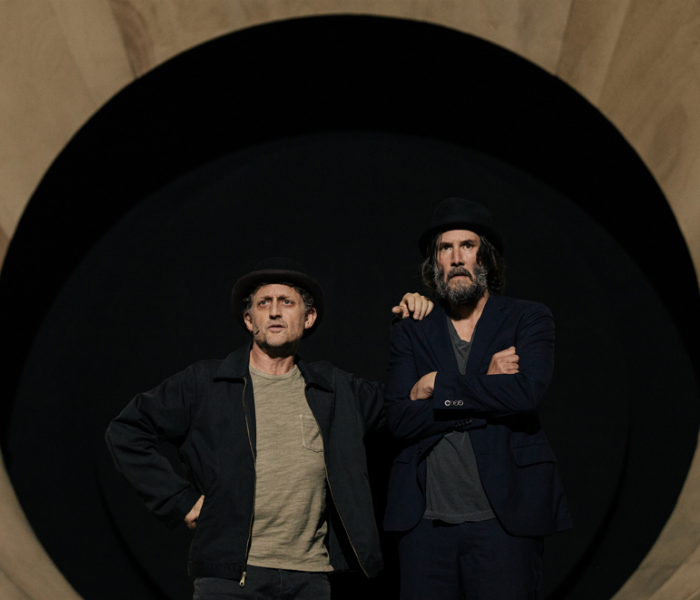
In the tragicomedy Waiting for Godot, two trampy pals bicker and bond on a country road while awaiting the arrival of a mysterious figure who might deliver them from their seemingly meaningless existence. Tony-winning director Jamie Lloyd, known for his stripped-down, celebrity-driven reinventions of classics (Sunset Blvd., A Doll’s House, Betrayal), helms the current Broadway production at the Hudson Theatre featuring erstwhile Bill & Ted costars Keanu Reeves and Alex Winter as the decrepit Estragon and Vladimir. Lloyd says “it instantly made sense” when the duo approached him about the project.
“It’s such a challenging play. What you need is two people who very deeply love and care for each other,” Lloyd explains. Reeves and Winter “have been friends for the best part of 40 years, and it’s the kind of chemistry that you can’t teach. They are effortless with the language and the comedy because they’re able to bounce off one another, instinctively and playfully. There is a great vaudevillian energy that is joyful and, in some ways, anarchic.”
Lloyd’s way into the enigmatic play was to focus on the language. “You start with the rhythm,” he says. “It’s almost like learning a song: you get the melody right, then the truth is revealed beneath the surface.” Beckett’s reputation as an uncompromising guardian of his texts is well-known, and his estate has rigorously upheld this adherence since the playwright’s death in 1989. Yet this mounting is pushing against some boundaries. The dialogue remains intact, but the actors pantomime all the props, and the characters are confined to an enormous, abstract tunnel, leaving the play’s signature solitary tree to the audience’s imagination. “The estate is less strict than its reputation would have it,” Lloyd reveals. “They’ve been collaborative and given us a lot of freedom to make the play our own. That’s because we respect the play very deeply and have done months of research. As long as we are true to the text, there’s room for flexibility.”
The English theatre critic Kenneth Tynan, one of the few to champion Waiting for Godot‘s English-language premiere 70 years ago, famously observed that to Beckett, “passing the time in the dark… is not only what drama is about but also what life is about.” For Lloyd, there is “something profound and beautiful” in the play’s portrait of our existence. “It’s saying this is our life—we’re born and then we’ll die, and somewhere in between we do all these ridiculous things. Beneath that, though, it’s about human connection and interdependence: how we cling to each other, need to be seen, supported and loved. That kind of companionship sustains us in the face of something very challenging, even despair.”
In Beckett’s searing solo Krapp’s Last Tape, Tony and Oscar nominee Stephen Rea plays the title curmudgeon, a sexagenarian listening to audio recordings he made 30 years earlier. Occasionally, Krapp attempts to make a new tape, recording his irritated reactions to his younger self as he contemplates the years gone by. Vicky Featherstone directs this poignant tour de force.
Back in 2009, Rea had privately recorded himself reading the younger Krapp’s text hoping to play the role at some point in the future. Seven years later, while working with Featherstone on the Abbey Theatre/Royal Court Theatre coproduction of Cyprus Avenue, he mentioned his aspiration. Featherstone was intrigued, but it took eight more years for the production to come together in 2024, when Rea had reached the age of 77. It was a full-circle journey for Rea: almost a half century prior, as a young actor at the Royal Court, Beckett himself had invited the up-and-comer to join a production of Endgame starring Patrick Magee—the very performer Beckett wrote Krapp’s Last Tape for back in 1958.
“Stephen has a real connection with Beckett’s work and really understands it,” says Featherstone. Rea told her that during his conversations with Beckett, the playwright shared an invaluable tip about acting: it’s just about listening. “And, of course, in Krapp’s Last Tape, that’s really all that he’s doing,” Featherstone notes. “He can only listen to himself because there is no one else there. We had this amazing moment when we sat down to listen to the tapes [Rea recorded in 2009] on the first day of rehearsal. It’s fascinating what happens to the voice. Often people work hard to make their voice sound younger, but this is a man who had a different outlook on life as an actor, as a human being, at that time. It’s very moving to see him onstage literally listening to his younger self.”
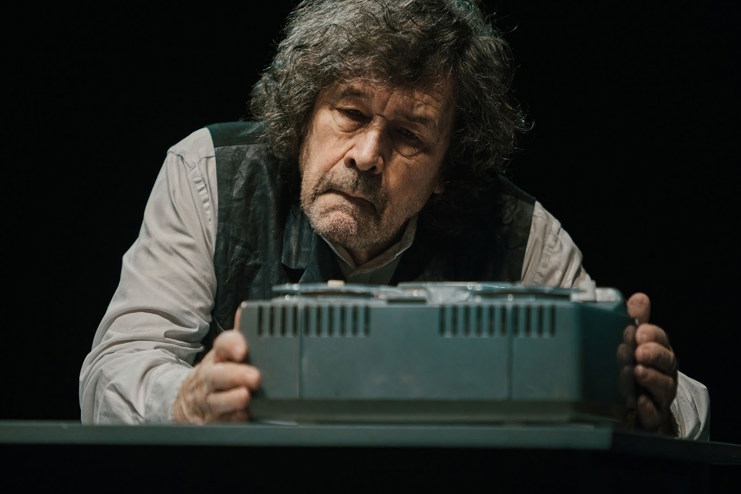
As Krapp plays his tapes, the audience pieces together fragments from his past, most movingly a missed opportunity for romance. “Krapp has this epiphany, which he cuts off on the tape—it’s deliberately frustrating for the audience—that to become a great writer he must follow his own truth, that love will get in the way,” says Featherstone. “I think he is really a fool for love, but he sabotages this relationship in order to become a great writer. At the end, he realizes he hasn’t, so his life has actually been meaningless.”
The former artistic director at the Royal Court, Featherstone has worked mostly on new plays during her career. So when reviving Krapp’s Last Tape, she consulted Beckett’s own detailed notes from the first production of the play he directed, in 1969 at Berlin’s Schiller Theatre. “I used those notebooks as if he was in the room and I could ask him questions,” she says. One preconceived notion she quickly dispensed with was the idea that Krapp sits in a fusty Dickensian-type room filled with paper and clutter. “There’s a stage direction at the beginning which says the play is set ‘somewhere in the future.’ That’s a big message about style and aesthetic. So we decided on a stark, slightly futuristic gray space. The rest of the space is a void—the thing Krapp’s scared of. There’s something incredibly painful and beautiful about seeing an older person in that space confronting humanity, life and death, and the darkness.”
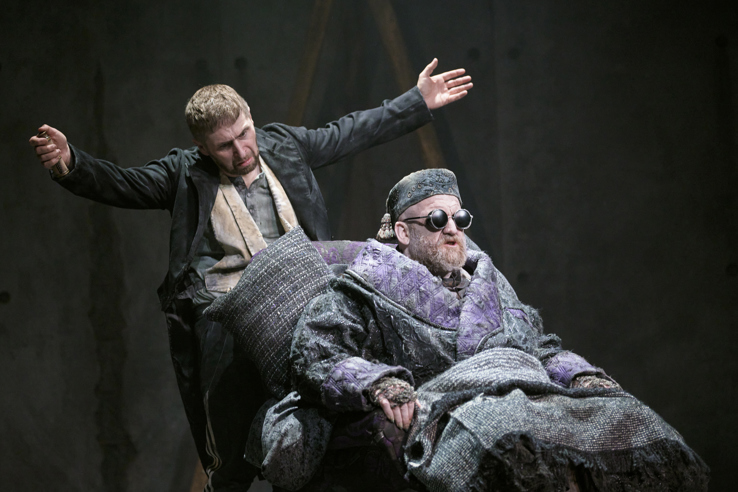
Endgameis the final Beckett play opening this fall. In this post-apocalyptic black comedy, a magisterial but immobile blind man, his two disabled parents confined to trash cans, and his servant wait for the inevitable. This production originated at Galway’s Druid Theatre and arrives in New York as part of the Irish touring company’s 50th anniversary season. Garry Hynes, Druid’s cofounder and a Tony Award winner for The Beauty Queen of Leenane, directs the revival, which features her fellow Druid cofounder and Tony winner Marie Mullen.
“Beckett has always been part of my imaginative hinterland in the sense that I understood and responded to the plays on a personal level,” says Hynes, who directed Waiting for Godot for Druid in 2016. “Beckett writes about a world which does not feel controllable by the people who occupy it. In Godot, you have two men waiting for someone they don’t know will arrive or not. In Endgame, the characters are reduced to the simple repetition of things and a lack of understanding of the nature of the world, or the reason for their presence in it. To me, that sounds like a pretty good description of the world we are living in right now.”
In Endgame, the blind autocrat Hamm (Rory Nolan) and his servant Clov (Aaron Monaghan) recall King Lear and his Fool, so even though they go nowhere, their relationship is inherently dramatic, as is the play itself. Beckett even draws attention to the fact that an audience is watching these characters go about their daily lives. “For me, that’s one of the great attractions of Beckett—the naked theatricality of the event,” says Hynes. “One of Beckett’s great achievements is to distill writing about the human condition to its purest theatrical—or metatheatrical—terms and, at the same time, by creating such a structured theatrical world, to allow the audience’s imagination to work in a very powerful way. Ultimately, what pulls your heart is the loneliness of the characters. Sometimes it’s like you are watching them from very far away. They seem so lonely, you wish you could comfort them, but you can’t.”
The late Irish actor Jack MacGowran, regarded as one of the foremost interpreters of Beckett, once remarked that the playwright had the “ability to write one line that contains tragedy and laughter at the same time.” In Endgame, Hamm’s mother famously declares, “Nothing is funnier than unhappiness.” Dark humor is an essential quality of the Beckettian experience, says Hynes. “Beckett’s voice—his turn of phrase and his sense of humor—is entirely Irish,” she asserts. Ironically, Beckett, who lived most of his adult life in France, originally wrote both Waiting for Godot and Endgame in French. “He essentially rewrote them in English or Anglo-Irish, a very curious way of doing it,” Hynes says. “It must have something to do with the quality of what eventually emerged.”
All three directors agree that Beckett’s work remains relevant because the things that ail and obsess us never change. “The plays don’t date,” Lloyd insists. “They enter into a conversation beyond the theatre’s walls, whatever is happening in the world. They offer a multiplicity of interpretations and examining them can reveal so many different things.”
For Featherstone, Beckett holds a mirror up to the insanity of the world. “What you’re seeing is human beings struggling to understand or survive against something that is really in opposition to living in so many ways,” she says. Still, it’s not for everyone. Hynes concedes, “I know there are certain people who have no affinity to the Beckett world and do not attend his plays. He’s distinctive and divisive in that way. But the genius of his imagination and his intellect seem to me almost godlike at times.” She pauses, then lets out a wry chuckle. “He’d probably be the last person to want to hear that said about him!”
—
TDF MEMBERS: At press time, discount tickets were available for Krapp’s Last Tape and Endgame. Go here to browse our latest discounts for dance, theatre and concerts.
Waiting for Godot is occasionally available at our TKTS Discount Booths.