

Show Finder
Miss Julie 1925 New Year's
Opening Date: Jan 9, 2025
Closing Date: Jan 26, 2025
Running Time: 01:15
Playing @
Theater for the New City
155 First Ave, New York, NY 10003
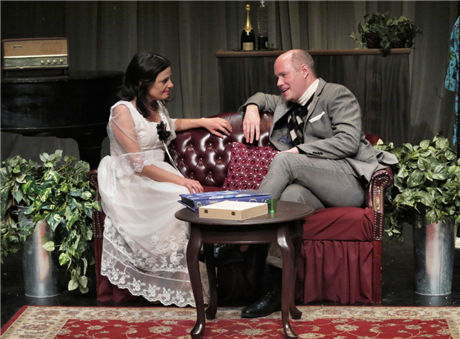
Miss Julie by August Strindberg centers on a proud, neurotic daughter of the degenerate aristocracy who is willing to sink her pride in a frenzied attempt to satisfy her love of sensation. Strindberg originally set the play in a Swedish manor house in 1888. Theater for the New City presents Strindberg Rep in a production, translated from the Swedish, adapted and directed by Robert Greer, that transplants Strindberg’s story to a Long Island country estate in 1925.
It’s an Americanized retelling of Strindberg’s classic drama. The engagement of the Governor’s daughter, Julie, to the County District Attorney has just been broken off. It’s New Year’s Eve and an extravagant party is underway, parallel to the midsummer festivities in Strindberg’s play. Julie, a young woman of privileged birth, is headstrong, domineering and emotionally volatile. On this particular evening, she engages in flirtatious and provocative behavior with the servants, particularly Jean, her father’s butler. The pair dance and drink at her insistence. Their dynamics are complex and fraught with tension, driven by a mix of attraction, power play and deep-seated class resentments. Jean discloses that he has been obsessed with Julie since childhood. As the night progresses, their interactions become increasingly intimate and manipulative. She, despite her upper-class status, reveals her vulnerability and desperation. He, ambitious and cunning, sees an opportunity to exploit her emotional instability to elevate his social standing.
Hearing the Governor’s roughneck field hands singing a lewd song about them, they hide in Jean’s room to avoid being discovered by these rowdies. Leaving the room, it is revealed that Jean has seduced Julie there. They plan to flee to Mexico and open a hotel, and she steals her father’s cash box to pay for the trip. But the power balance has shifted. Julie’s initial authority over Jean crumbles as he begins to assert dominance, revealing his contempt for her aristocratic pretensions and her emotional weakness. Ultimately their plan is thwarted when Jean’s fiancée, Christine (the cook), announces that she, enroute to church, will tell the chauffeur not to give anybody the car keys should they try to get away before the Governor comes home.
Moving Strindberg’s play, with its extreme class consciousness, to an American setting might seem surprising, but it’s a peek into our American social hierarchy that cautions us against the 21st century redistribution of wealth which is becoming hardened in our society. The notion that America is a classless society has always been more myth than reality. In the jazz age, rich sections of Long Island, such as the Gold Coast, were known for their opulent mansions and wealthy residents, starkly contrasting the working-class individuals who served them. So the setting provides a backdrop of class distinction, mirroring the original play’s focus on class struggle.
It’s an Americanized retelling of Strindberg’s classic drama. The engagement of the Governor’s daughter, Julie, to the County District Attorney has just been broken off. It’s New Year’s Eve and an extravagant party is underway, parallel to the midsummer festivities in Strindberg’s play. Julie, a young woman of privileged birth, is headstrong, domineering and emotionally volatile. On this particular evening, she engages in flirtatious and provocative behavior with the servants, particularly Jean, her father’s butler. The pair dance and drink at her insistence. Their dynamics are complex and fraught with tension, driven by a mix of attraction, power play and deep-seated class resentments. Jean discloses that he has been obsessed with Julie since childhood. As the night progresses, their interactions become increasingly intimate and manipulative. She, despite her upper-class status, reveals her vulnerability and desperation. He, ambitious and cunning, sees an opportunity to exploit her emotional instability to elevate his social standing.
Hearing the Governor’s roughneck field hands singing a lewd song about them, they hide in Jean’s room to avoid being discovered by these rowdies. Leaving the room, it is revealed that Jean has seduced Julie there. They plan to flee to Mexico and open a hotel, and she steals her father’s cash box to pay for the trip. But the power balance has shifted. Julie’s initial authority over Jean crumbles as he begins to assert dominance, revealing his contempt for her aristocratic pretensions and her emotional weakness. Ultimately their plan is thwarted when Jean’s fiancée, Christine (the cook), announces that she, enroute to church, will tell the chauffeur not to give anybody the car keys should they try to get away before the Governor comes home.
Moving Strindberg’s play, with its extreme class consciousness, to an American setting might seem surprising, but it’s a peek into our American social hierarchy that cautions us against the 21st century redistribution of wealth which is becoming hardened in our society. The notion that America is a classless society has always been more myth than reality. In the jazz age, rich sections of Long Island, such as the Gold Coast, were known for their opulent mansions and wealthy residents, starkly contrasting the working-class individuals who served them. So the setting provides a backdrop of class distinction, mirroring the original play’s focus on class struggle.

Performance Schedule
THURSDAY-SATURDAY @ 8 PM
SUNDAY @ 3 PM
Written By
- August Strindberg
- translated and adapted by Robert Greer
Director
- Robert Greer
TDF Tickets Offers:
TDF Member tickets:
Not currently available for this show
Listed at 
Never
Full-price tickets:
$23.00 - $23.00
Accessibility
-
Box Office
Counter 43". -
Parking
SVI Permit. -
Curb Ramps
All corners. -
Passenger Loading Zone
Front. -
Restroom
Unisex: Lobby. Lightweight door 33". Stall 66" x 68". Commode 19". Grab bars. -
Seating
Four Theatres: Three on lobby-level (one seating 240, two seating 99 each), one in basement (seats 65). No fixed seating in any of the theaters. -
Elevator/Escalator
Elevator: For access to basement theater. Lift for one person using wheelchair and one ambulatory person. Operated with key by house manager. -
Telephone
Lobby. Coin slot 61". Cord 29". -
Entrance
Ground level. Double doors in series (each 36"). Easy to operate with adequate maneuvering space. -
Visual Assistance
None. -
Water Fountain
None. -
Assisted Listening System
None. -
Wheelchair Info
No fixed seating in any of the theaters.