
Show Finder
Apollo Theatre
Website:
www.apollotheater.org.
Address
253 West 125 St
New York, NY 10027
Public Transport
Theater Description
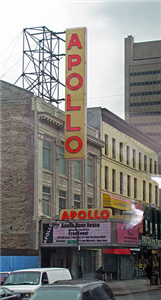
The Apollo Theater at 253 West 125th Street between Adam Clayton Powell Jr. Boulevard and Frederick Douglass Boulevard in the Harlem neighborhood of Manhattan, New York City[3] is a music hall which is a noted venue for African-American performers. It was the home of Showtime at the Apollo, a nationally syndicated television variety show which showcased new talent, from 1987 to 2008, encompassing 1093 episodes.The theater, which has a capacity of 1506, was built in 1913-14 as Hurtig & Seamon's New Burlesque Theater, and was designed by George Keister in the neo-Classical style.[2] It became the Apollo in 1934, when it was opened to black patrons – previously it had been a whites-only venue.[3] In 1983 both the interior and exterior of the building were designated as New York City Landmarks, and the building was added to the National Register of Historic Places. It is estimated that 1.3 million people visit the Apollo every year.
The building which later became the Apollo Theater was built in 1913-14[2] and was designed by architect George Keister,[4] who also designed the First Baptist Church in the City of New York. It was originally Hurtig and Seamon's New (Burlesque) Theater, which enforced a strict "Whites Only" policy.[5] The theatre was operated by noted burlesque producers Jules Hurtig and Harry Seamon, who obtained a 30-year lease.[4] It remained in operation until 1928, when Billy Minsky took over.[citation needed] The song "I May Be Wrong (But I Think You're Wonderful)" by Harry Sullivan and Harry Ruskin, written in 1929, became the theme song of the theater..
During the early 1930s the theatre fell into disrepair and closed once more. In 1933 it was purchased by Sidney Cohen, who owned other theaters in the area,[6] and after lavish renovations it re-opened as the "Apollo Theater" on January 16, 1934,[5] catering to the black community of Harlem.[3] On February 14, 1934, the first major star to appear at the Apollo was jazz singer and Broadway star Adelaide Hall in Clarence Robinson's production Chocolate Soldiers, which featured Sam Wooding's Orchestra. The show ran for a limited engagement and was highly praised by the press, which helped establish the Apollo's reputation.
Managed by Morris Sussman, Cohen's Apollo Theatre had vigorous competition from other venues, such as the Lafayette, managed by Frank Schiffman, which presented acts such as Louis Armstrong, Bill "Bojangles" Robinson and Bessie Smith. Leo Brecher's Harlem Opera House was another competing venue. To improve the shows at the Apollo, Cohen hired noted talent scout John Hammond to book his shows. However, the deal fell through when Cohen died, and the end result was the merger of the Apollo with the Harlem Opera House. The Opera House became a movie theater, but the Apollo, under the ownership of Brecher and Schiffman, continued to present stage shows.[6] Schiffman hired Clarence Robinson as in-house producer,
Originally, a typical show presented at the Apollo was akin to a vaudeville show, including a chorus line of beautiful girls. As the years progressed, such variety shows were presented less often.
During the swing era, along with bands such as Duke Ellington, Dizzy Gillespie, Chick Webb, Count Basie and Andy Kirk, the Apollo also presented dance acts such as Bill Robinson, the Nicholas Brothers, Carmen De Lavallade and Geoffrey Holder, the Berry Brothers and Buck and Bubbles.[6] Comic acts also appeared on the Apollo stage, including those who performed in blackface, such as Butterbeans and Susie, much to the horror of the NAACP and the elite of Harlem.
The Apollo also featured the performances of old-time vaudeville favorites like Tim Moore, Stepin Fetchit, Moms Mabley, Dewey "Pigmeat" Markham, Clinton "Dusty" Fletcher, John "Spider Bruce" Mason, and Johnny Lee, as well as younger comics like Bill Cosby, Godfrey Cambridge, LaWanda Page, Richard Pryor, Rudy Ray Moore and Redd Foxx.
Gospel acts which played the Apollo include the Staple Singers, Mahalia Jackson, The Clark Sisters, Sister Rosetta Tharpe, Clara Ward and Sam Cooke with the Soul Stirrers.[6] Performers of soul music on the Apollo stage included Ray Charles, Otis Redding and Aretha Franklin, and jazz was represented as well, by acts such as Art Blakey and Horace Silver.
Although the theatre concentrated on showcasing African American acts, it also presented white acts such as Harry James, Woody Herman and Charlie Barnet during the swing era, and, later, Dave Brubeck, Stan Getz and Buddy Rich, who was a particular favorite of the Apollo crowd. The theater's audience was often mixed: in the 1940s it was estimated that during the week about 40% of the audience was white, which would go up to 75 percent for weekend shows.[6] Jazz singer Anita O'Day headlined for the week of September 21, 1950, billed as "the Jezebel of Jazz".


