

Show Finder
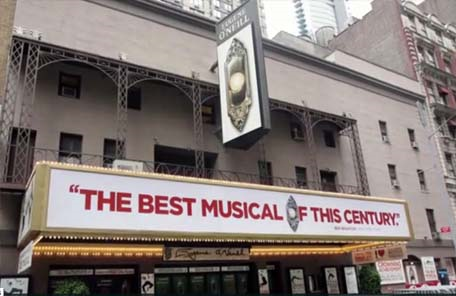
Eugene O'Neill Theatre
Address
230 West 49th Street
New York City, NY 10036
Public Transport
Accessibility
-
Box Office
Lobby. Counter 46" -
Curb Ramps
SW corner of 49th St. & Broadway; SE corner of 49th St. & 8th Ave. -
Restroom
For accessible, single-stall and/or all-gender restroom options, please speak with a member of the theatre staff who can guide you to The Time Hotel, located directly adjacent to the theatre at 224 West 49th Street. -
Elevator/Escalator
None -
Entrance
Double doors in series: 1st set (each 27") to lobby. Up slope and through 2nd set (each 26") into theater. -
Visual Assistance
Low vision seats are available online and in person. -
Assisted Listening System
Reservations are not necessary. Drivers license or ID with printed address required as a deposit. Please call: (212) 582-7678 to reserve in advance. -
Wheelchair Info
Wheelchair seating available -
Folding Armrests
Mobility seats with folding armrests are available for purchase online, in person, or on the phone.
Theater Description
Designed by architect Herbert J. Krapp, it was built for the Shuberts as part of a theatre-hotel complex named for 19th century tragedian Edwin Forrest. It opened on November 24, 1925 with the musical Mayflowers as its premiere production.The venue was renamed the Coronet in 1945, with renovations by architects Walker & Gillette, then in 1959 rechristened the O'Neill in honor of the American playwright by then-owner Lester Osterman. It later was purchased by playwright Neil Simon, who sold it to Jujamcyn Theaters in 1982.
At the time it was built, in 1925, there were already 192 playhouses and 548 motion picture houses competing for patrons. The Shuberts tried to attract audiences with promotions such as free coffee, cigarettes, and perfume as well as the free services of silhouette artists and mind readers. Mostly due to the bar in the Forrest Hotel that was accessed through the orchestra, the theater was one of the few to survive the Depression. Ultimately it was auctioned in 1934 and leased to the producers of Tobacco Road, a provocative Depression-era play that was performed until 1941, making it the longest running play on Broadway at the time. Designed by Herbert J. Krapp, it was the first theater to use steel frame construction, which had only previously been used for skyscrapers and large apartment buildings. Krapp installed the most up-to-date stage curtain as well as an innovative system for moving stage scenery with electricity. One of Krapp’s most ornate theaters, the interior was adorned with decorative plasterwork. In 1953 theater was renamed the Eugene O’Neill; it was, the first theater to be named after a playwright. In the late 1960s Neil Simon bought the theater and presented seven of his plays there. In 1982 the Jujamcyn Company bought it with the goal of presenting new American work and succeeded with such plays as M. Butterfly, Spring Awakening, and The Book of Mormon.


