
Going Back to the Future with ‘Marjorie Prime,’ This Time on Broadway

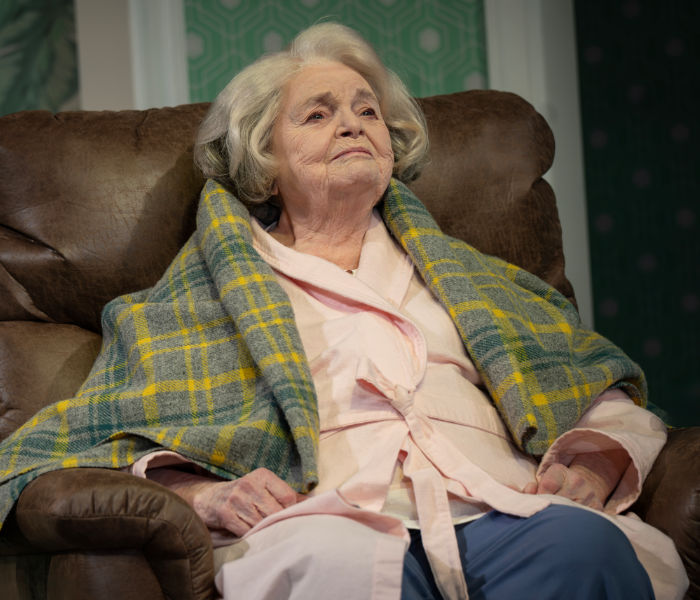
Dramatist Jordan Harrison and director Anne Kauffman on revisiting the Pulitzer finalist play a decade on
—
Some plays date quickly, but Jordan Harrison’s 11-year-old Marjorie Prime feels like it was written yesterday… or even tomorrow. Set in the mid-21st century, the one-act revolves around Marjorie, an 85-year-old widow whose mind is slipping. To keep her engaged, her anxious daughter Tess and compassionate son-in-law Jon enlist an AI companion, aka a Prime, to serve as an empathetic aide. Previously seen in New York at Playwrights Horizons in 2015 and adapted as an indie film in 2017, this deeply affecting family drama is a profound exploration of memory, aging and family dynamics.
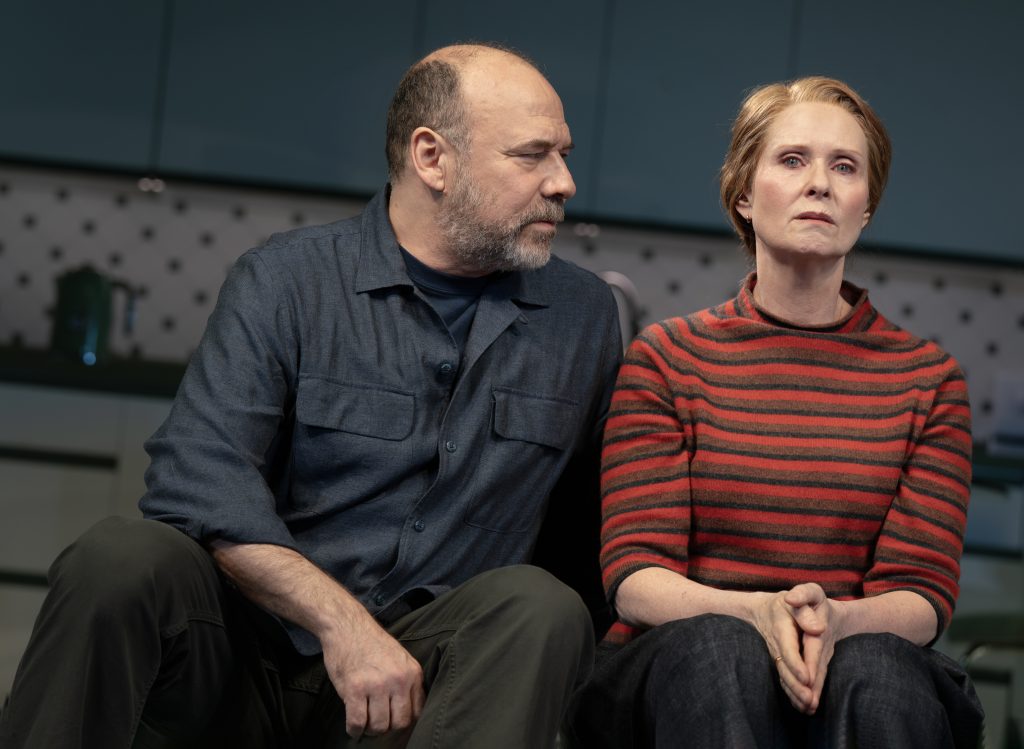
Tony nominee Anne Kauffman helmed Marjorie Prime 10 years ago and now returns to direct the Pulitzer finalist play on Broadway for Second Stage Theater. The in-demand, nonagenarian character actor June Squibb (Thelma, Waitress) stars as the title character, Tony winners Cynthia Nixon and Danny Burstein are Tess and Jon, and Christopher Lowell is Marjorie’s Prime, made to resemble her late husband in his youth.
TDF Stages chatted with Harrison and Kauffman about reuniting for this remarkable work, which has grown uncomfortably closer to reality since its 2014 debut.
Gerard Raymond: How does it feel to return to Marjorie Prime after all these years?
Anne Kauffman: I love revisiting passion projects! You know it’s a classic when you keep unearthing things as you work on it over and over again. I’m now in my late fifties and things are resonating in a whole new way for me.
[To Harrison] You were prescient in terms of the AI technology, but also emotionally prescient, I think, in terms of age and aging.
Jordan Harrison: That’s a nice thing to say! What I tend to say is my superpower is just being anxious about this a little sooner than other people. I certainly live in an anxiousness about how technology is changing and what it means to be human. But I try to make work that is ambivalent about technology. There are a lot of times in this play where the AI seems to be a little more empathic and a little more human than the humans themselves.
When the play premiered at the Mark Taper Forum [in Los Angeles in 2014] and then went to Playwrights Horizons, I remember a fair number of people asking, “What’s a chatbot? What’s AI?” Revisiting it, I love the thought of having an audience that is sophisticated about these issues. Now the idea of having AI in your house, or responding to it emotionally, is a familiar idea. Everyone has a personal experience—like my friend telling her kid how to talk to Alexa not too intimately, or support groups for people who are married to someone who uses an AI therapist. I think people will be even more open to the play for that reason.
Kauffman: In the past, the artificiality of computers was something we were building into the acting. Now, because computers have gotten so good at mimicking humans, the task is how human can they be?
Harrison: We’re so used to the idea that these things can replicate human cadence and human emotion that it’s often only the language that flags for us that they’re nonhuman—when they say something like, “I’m afraid I don’t have that information.”
Kauffman: There’s a line in the play: “Science fiction is here;” it’s a new realism. But I was thinking into the future and wondering: What will this play be like in 50 years? And I think it will still be relevant because when you come down to it, it really is a family drama. In that way a classic, you know, sort of Greek.
Raymond: How do you avoid sci-fi clichés when directing actors to play both human and nonhuman?
Kauffman: The way that I describe being a Prime is that they’re sort of an innocent looking for information. Now that computers are getting to be so close to human beings, I’m directing them to be human in a way. I think we’re more interested now not in the audience guessing who’s a Prime but in being truly fooled, like in a Turing test.
Raymond: The play also explores the mutability of memory, how it can be unreliable and selective.
Kauffman: I find memory to be one of the more mysterious things in the play. It’s very compelling watching someone piece together a memory that feels so long ago. The action of trying to recall it is such a human endeavor. I’m menopausal now and I have a much more difficult time picking memories out. These Primes are supposed to be helping with memory, so I find that to be a kind of wish fulfillment. I am Tess’ age now. My mom did pass away though I had a very good relationship with her as opposed to [the mother-daughter relationship in] this play. I like passing through the stages of the different characters’ lives. I would like to direct the play in another…I don’t know…
Harrison: I can’t predict what it would mean to do the play in 50 years, when I am older than [Marjorie]. This is kind of trippy, isn’t it? You’re breaking my brain! Let’s meet again when I’m 85!
Kauffman: Yeah, and I’m 95!
Raymond: The two of you have worked on several plays together over the years. What keeps your collaboration going?
Harrison: [laughing] Yes, how can you bear it?
Kauffman: Jordan is one of our great wordsmiths. He is one of those writers who creates worlds through his language. In every play of his I’ve directed, there’s a world of fantasy and a world of reality. Jordan is always dreaming of these embattled worlds—how they are separate like oil and water, and how they impact each other. I feel like Jordan has the ability to put that onstage in a way that’s really clear and recognizable, and odd and mysterious.
Harrison: In addition to language, the other thing that I care about is structure. Hearing, for instance, the story about adopting the dog in the first scene and then hearing it shift a little at the end of the play. There’s something about the things an audience learns together over the course of an hour and a half that is collectively experienced —that’s one of the things I enjoy using as a tool the most.
Raymond: In the original production, Lois Smith played Marjorie when she was the same age as the character: 85. This time around the fabulous June Squibb, who is 96, portrays Marjorie. Is it challenging to find actors of a certain age who are up for this part?
Harrison: I’ve met actors who don’t want to live in the subject matter for [an extended period], who might be thinking about whether they’re going to experience dementia themselves and who are sensitive to that. But I have never gotten any kind of fear from June about it, just as we never had any fear from Lois about it. I just feel enormously lucky to have cast the play with these two extraordinary women.
Kauffman: I actually feel that June may be one of the most fearless actors I’ve ever worked with. I mean, this is a woman who flew across the country for a one-day shoot [for the upcoming season of American Horror Story] to play a vampire because she’s never played a vampire before. Then she realized, oh, it’s a bloodsucking leprechaun! But she’s hungry to play it all.
Raymond: Marjorie was born in 1977, just like you Jordan. Did you use your own experiences for her life story?
Harrison: It’s not only my own life and experiences that’re stitched into it, but also my grandmother’s. I knew I was embarking on a play where people sit on couches and talk about feelings and deep family history. That doesn’t come naturally to me. My natural state is making up things like a wild play world—things you don’t see on planet Earth. So the way I did it was to fill this play with things that really happened. Marjorie says things that my grandmother actually said, that my parents took down in a notebook in the final year of her life, like, “I remember waking up on a bridge with a lot of people around.” We didn’t know what that meant then and still don’t. There are these islands of verisimilitude in the play that I needed, and I hoped, would help me make the play emotional and deep.
Kauffman: I love that: “islands of verisimilitude.”
Harrison: There’s a whole movie that passes before my eyes when I hear that sentence about the bridge. I guess I felt like pulling my grandmother Ruth into this conversation for a moment, because the play is a sort of tribute to her, and I’m sorry she didn’t ever get to see it.
—
This interview has been edited for length and clarity.
Marjorie Prime is frequently available at our TKTS Discount Booths.
TDF MEMBERS: Go here to browse our latest discounts for dance, theatre and concerts.