
Meet the Two Friends Behind ‘Two Strangers’


Longtime collaborators Kit Buchan and Jim Barne make their Broadway debut with a two-person musical comedy set in NYC
—
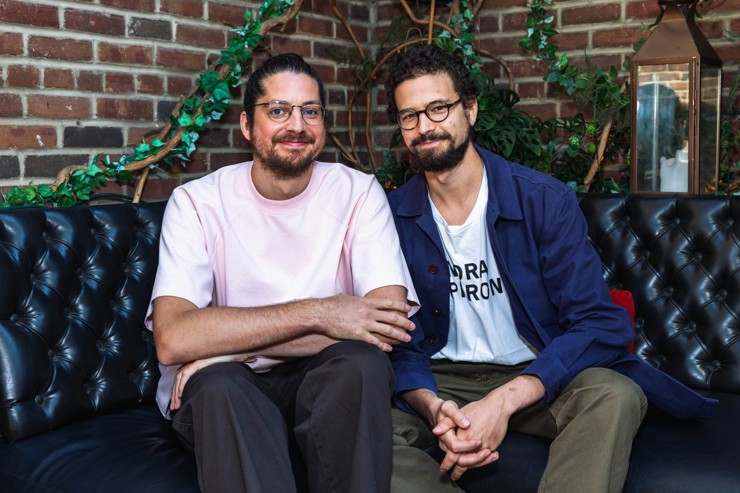
The creators of the new Broadway musical Two Strangers (Who Carry a Cake Across New York) are not strangers. They’re not from New York, either.
Unlike the title characters of their two-person musical comedy, they have known each other for most of their lives. In fact, British mates Jim Barne and Kit Buchan—both credited with the show’s songs and book—first met when they were 9 years old in elementary school. After celebrated runs in London and at Massachusetts’ American Repertory Theater, Two Strangers arrives in NYC at the Longacre Theatre, marking the duo’s Broadway debut.
Both a rom-com and a gentle parody of the genre, the musical centers on a young Englishman named Dougal (Sam Tutty), who arrives in NYC at Christmastime to attend the wedding of the father he’s never met. The bride’s jaded younger sister, native New Yorker Robin (Christiani Pitts), fetches him from the airport and comedic chaos ensues as they run last-minute errands for the big event, including picking up an expensive cake. It’s a tuneful setup for surprising family secrets, lots of laughs and unexpected love.
TDF spoke with Barne and Buchan about Two Strangers‘ journey to Broadway, the “mythological magnetism” of New York City and how multiple failures led to their musical theatre success.
Sarah Rebell: You’ve been friends since childhood. When did you start writing songs together?
Kit Buchan: We formed a band in our teens but went our separate ways career-wise. I was trying to be a journalist and was writing poetry. Jim was trying to be a film composer and was also working as a music publisher. I think one ingredient that made it possible for us to write a musical was that neither of us were very successful at anything else! Another thing that was helpful is that the band wasn’t successful, either. It was fun, but we just booked the odd gig in a pub, we never got it off the ground.
Jim Barne: All the other members of the band started to drift off into their careers, and we were left looking at each other in the rehearsal room. Our entire journey in musical theatre has been together. I think it was just an excuse for continuing to hang out and write songs.
Rebell: Describe your creative process: Do you prefer to write music or lyrics first, or sit in a room together and hash it out?
Buchan: When I hear this question posed to other musical theatre writers, they tend to have a codified approach, but ours continues to evolve. When we were first writing musicals, I would deliver Jim a great big lyric, and then he would make a song out of it. But more often now, we’ll be in the same room and write a bit of this and a bit of that, which, incidentally, is more how we used to write pop songs.
Barne: I do ask for a dummy lyric to start writing the song quite a lot. I get very fond of the lyrics I’m given, and then Kit tries to change them.
Buchan: It happens in reverse as well. Jim’s often like, “Don’t get married to this melody.” And I’m like, “I love it. Please don’t ever change it.”
Rebell: In Two Strangers, Dougal and Robin often sing about everyday things, like scrolling on a dating app or serving coffee. How do you heighten these mundane activities so they’re something to sing about?
Barne: That was certainly something we set out to do at the very beginning. We had a wager with ourselves, that we could write a musical about ordinary people and it would still be enjoyable to watch. I guess it’s the antithesis of a Marvel film. Basically, we believed that you could tell a story that was emotionally rewarding, even if the stakes were quite low.
Rebell: There’s something really relatable and refreshing about a story that focuses on two typical folks, especially in a big intense city. What are some of the challenges of writing a musical with only two characters?
Buchan: We thought we were making our lives easy when we set out to do it, because we were idiots! We were wrong in all kinds of respects. But we created a set of unshakable restraints, which we and other members of the creative team have flourished in. Our magnificent director, Tim Jackson, read the show and didn’t think: Oh, this is a little chamber piece for a Fringe theatre. He thought: There’s a great big show here. It just happens to have two people in it. The two performers are, in a way, dwarfed by the enormity of the city, which is all conjured by the set and lighting and sound. That is, I think, dramatic and poignant.
Rebell: In a way it’s a three-person musical since Two Strangers manages to make NYC feel like a character in the show. How did you approach that concept?
Barne: There are a lot of sound effects, maybe an unusually high number, in the show, because I’ve worked in film where the idea of layering music and sound effects and dialogue is more common. There’s one song called “This Is the Place” when Robin and Dougal go to Flatbush, Brooklyn. The whole song has an underlying bed of trains rumbling past, birds taking off, taxi cabs and stuff like that. It’s like a subliminal sort of fizziness.
Buchan: There’s something about New York—it’s the most familiar city in the world, and you can conjure it with quite light strokes. Even people who haven’t been here recognize what New York represents, whether it’s architecture, signage, sounds. New York is the only city that has this mythological magnetism. New York doesn’t let you down. As Londoners, we sometimes worry that people who come to London with a fantasy of London might be disappointed, but New York is so New York, and it’s really thrilling.
Rebell: The show takes place in New York, but you wrote the musical in the UK and the first few productions were on your side of the pond. How has the show evolved over the years and what’s it like finally bringing it to the city where it’s set?
Barne: Every time we took the show to a new city and a new audience, we were very much thinking about how it would be received. We were very lucky at various points in the process to have had on-the-ground American consultants.
Buchan: We understood the necessity to make it realistic. Even from those early days, anything that didn’t ring true really began to stand out like a sore thumb. We’ve benefited from our previous cast members who played the character of Robin. The first actor who played it was born in New York, and the second had family in New York and spent a lot of time here, and obviously Christiani has lived here for many years. But also, we have a dramaturg who is a New Yorker and has been very influential in understanding the mindset.
Rebell: Can you give an example of an update you made for the sake of authenticity?
Buchan: There are so many granular details that you couldn’t know unless you were actually a New Yorker. At the beginning of the show, we have a series of radio broadcasts, and one of them is a traffic report. We used to use the phrase “Brooklyn-Queens Expressway.” Then we were told in no uncertain terms that no New Yorker would ever say that in full! And there’s some fun stuff about the trajectories that they take on public transport, or where Dougal might be staying. It’s been lovely to come here and talk to people about it.
Rebell: I find it really interesting that Two Strangers, a quirky and intimate original musical, got its start in another country before coming to Broadway, just like last season’s big Tony Award winner Maybe Happy Ending. What do you think this indicates about the development process and opportunities for original musicals, especially when so few are profitable these days?
Barne: In art, we’re often looking for something that’s familiar but also isn’t the same as something else. It’s like when jazz went to Brazil and we got bossa nova, which is reminiscent of jazz but different. There’s always been an appetite for musical theatre in the US, but globally, there’s more of an appetite for it now. We’re probably doing stuff that no American would do because we aren’t from the home of musical theatre. Maybe that’s an interesting byproduct of traveling through the lens of a different culture.
Buchan: In London, we have a cost-of-living crisis. Judging by the recent election, there’s one here as well. Maybe as a result of there being a bit of an economic maelstrom in the theatre industry, people have been drawn to Fringe shows more and developed a taste for that. In London, for example, two of the biggest shows—written by people we really admire—are SIX and Operation Mincemeat, both of which began at the Edinburgh Fringe. And they’ve made it to Broadway as well. Also, I think we belong to a generation of people who have worked up an appetite for stories about ordinary people doing ordinary things, rather than extraordinary people doing extraordinary things. Maybe it’s a democratization of the storytelling of musical theatre.
This interview has been edited for length and clarity.
—
Two Strangers is frequently available at our TKTS Discount Booths.
TDF MEMBERS: Go here to browse our latest discounts for dance, theatre and concerts.