
‘Slam Frank’ Is Opening Off Broadway. The Creators Say Bring on the Controversy

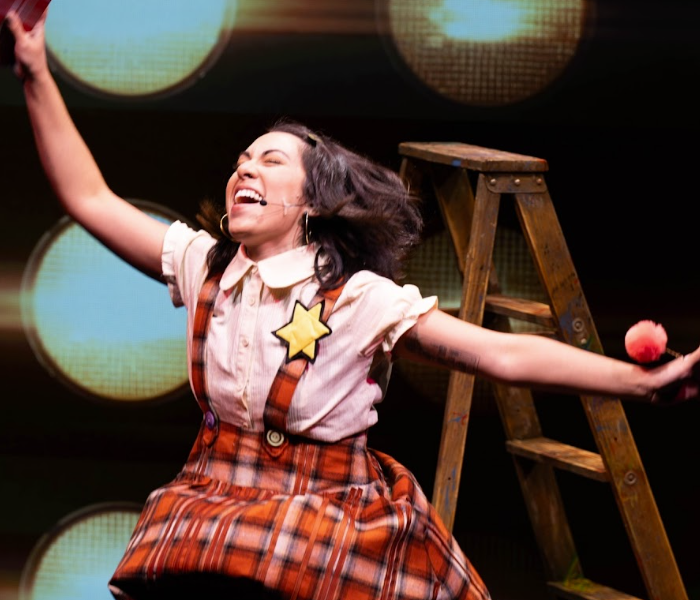
How Andrew Fox and Joel Sinensky made a “Springtime for Hitler” for the 21st century
—
The origin story of the musical Slam Frank has achieved mythic status, even though it’s 100% true. In 2022, composer Andrew Fox spied a Twitter thread that asked the ahistorical, absurdist question: “Did Anne Frank ever acknowledge her white privilege?”
That (perhaps satirical) query, which ignored the horrifying realities of Nazi Germany’s program of cultural and religious eradication, sparked intense debate. It also inspired Fox to seek out his childhood friend and eighth grade Anything Goes castmate, writer Joel Sinensky, for the first time in 15 years. Together, they embarked on a rapid-fire creative journey that included viral social media videos, a sold-out run at Asylum NYC last year and now a full-fledged Slam Frank production at Off Broadway’s Orpheum Theatre, running through November 30.
A show within a show, Slam Frank is not a satire of Anne Frank but of political correctness run amok as a regional theatre company, struggling to stay au courant, mounts a version of her story with the Jewish teenager reimagined as the Latinx Anita, Mr. Frank as indeterminately neurodivergent, Mrs. Frank as a Black woman, etc. This broad burlesque, set to a full, Hamilton-esque score that ranges from musical comedy to rap, feels akin to a modern-day “Springtime for Hitler” from Mel Brooks’ The Producers, another outrageously funny show within a show that pushed buttons and boundaries.
According to Fox and Sinensky, it took just a year to get to their inaugural private table read, followed by their first public concert performance of the material six months later. Two months after that, Slam Frank had its world premiere at the cozy Asylum NYC, where it ran for the entire fall of 2025. Now Fox and Sinensky are co-producers on the Off-Broadway production, and they credit their unusually fast timeline with helping to make Slam Frank a success.
“With what a sort of ordeal it is to create and produce a new musical, they become aesthetically conservative,” Sinensky notes. “I think as a form, it’s great. It has a lot of potential. I just think a lot of what gets produced is not the most exciting work.”
Fox agrees. “If in the 1960s they had the same pipeline length they have now, Hair would have opened in 1982!”
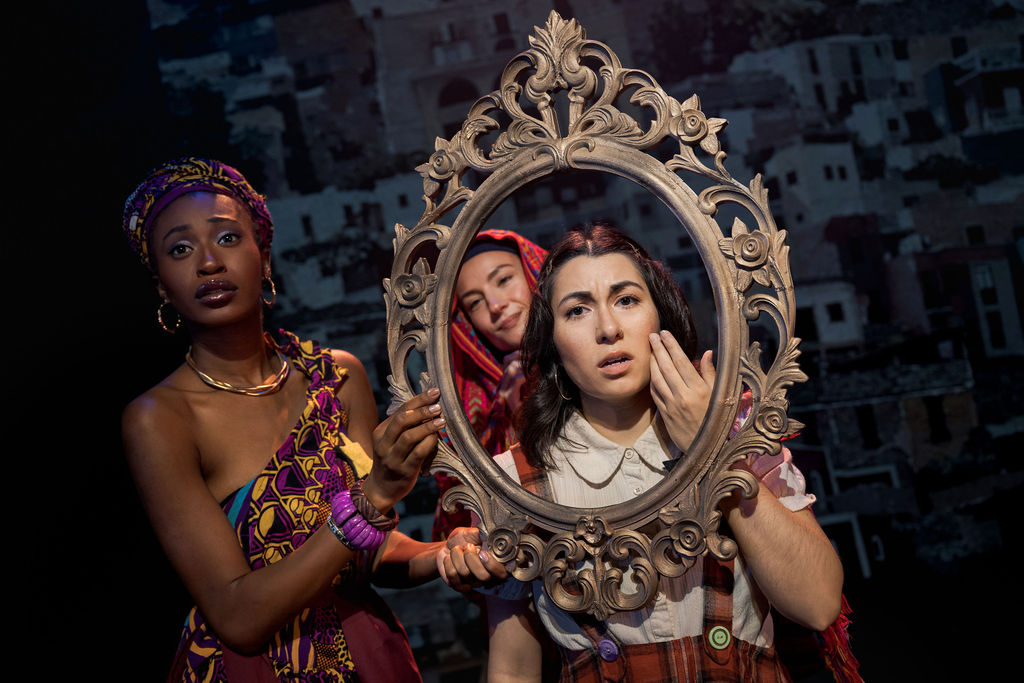
While they may not like the traditional musical development process, the duo loves musicals—Fox’s treasured theatre memories include seeing productions of Sweeney Todd, Carousel and Merrily We Roll Along with his grandmother. “If you listen to Andrew’s score for the show, it’s so steeped in knowledge of musical theatre,” says Sinensky. “It has so many references, so many interpolations of other musicals and musical styles. There is clearly a lot of deep love there.”
As quickly as they wrote, Fox admits that recent world events prompted them to work even faster. “That allowed us to hit something as it was happening,” he says, purposefully eschewing specifics, “although now there’s already people telling us this material is dated. How long do people think a musical takes to make? This isn’t SNL!”
Since the Asylum NYC incarnation closed, the pair has continued working on the show. One song has been replaced and there are significant physical changes since the Orpheum allows for a full staging. “We have the opportunity to have really beautiful stage images,” says Fox. “And when the songs hit, to have them hit like you’re at a hip-hop concert.”
For all of the show’s irreverence, the creators don’t want it seen solely as a travesty of a historical incident, especially when plays about Jewish identity such as Giant and Birthright are receiving attention and acclaim.
“We are both very serious about the themes and the deeper concepts and ideas the show presents,” says Sinensky. “That’s the thing about the front-facing image of Slam Frank, whether it’s silly or controversial or a kind of troll mentality. That’s intentionally meant to obfuscate. In this new version, more than anything, our rewrites have worked to bring those themes out.”
Fox concurs. “Deep down, I think this show comes from a really dark, sad, angry, thoughtful place that’s trying to wrestle with big ideas…”
“… but not in a ‘let me tell you about our ideas’ way,” adds Sinensky. “We’re going for entertainment and shock and comedy as hard as we can, not instructing you.”
That’s a big reason why Fox and Sinensky have been careful not to reveal their personal political leanings. “We don’t necessarily have the same political beliefs and that’s part of why I think we work so well together,” Sinensky says. “Aesthetically, creatively, politically, all of these things are not always aligned. For me, the show has always been a reaction to theatre that instructs you about what to believe and basically tells you this is what the authors believe. If you’re stating what you, as the author, believes, then you’re undercutting the purpose of the art, which is to be interpreted by the audience.”
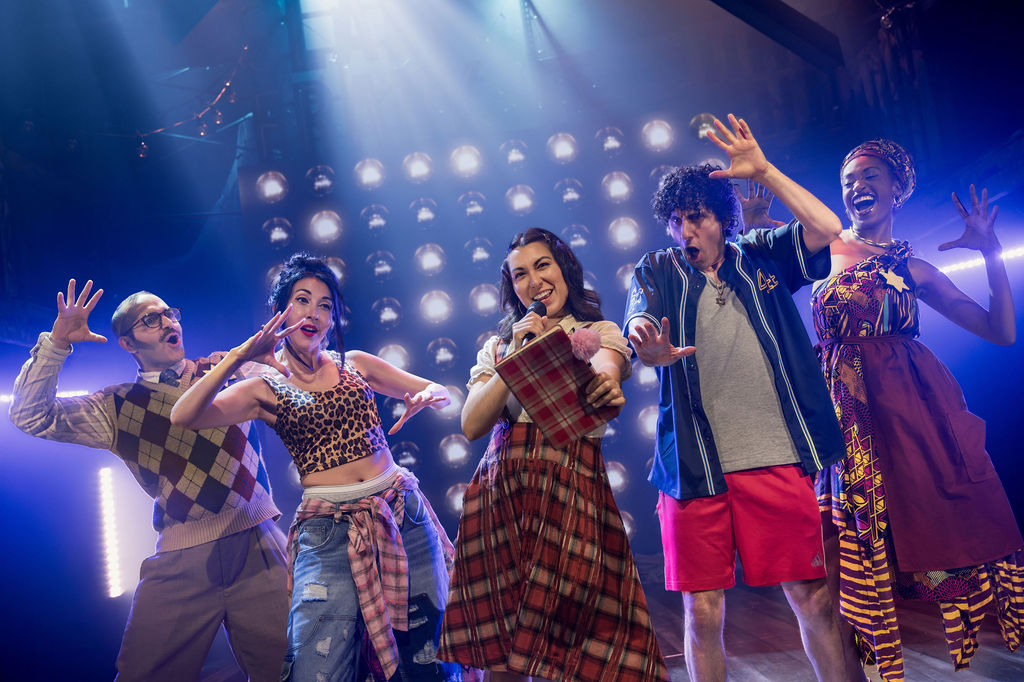
Indeed, Slam Frank yields wildly different interpretations. Some say it is anti-Semitic, while others say it mocks anti-Semites. Is it pro-Zionist or anti-Zionist, or neither? Is the show a Rorschach test on matters surrounding Jewish identity? With no stated perspective, the Asylum NYC run revealed that no two audience members may see it the same way.
Fox encourages curious theatregoers to come and decide for themselves. “Go into this temple of absurdity and wrestle with something from every angle and not know how you feel and not know how you think and come out of that place a deeper and more complex person,” he says.
Given the musical’s almost gleeful takedown of commonly held pieties along with its lampooning of revered source material, it’s easy to wonder whether Fox and Sinensky ever felt, while writing, that they had gone too far.
“All the time!” Fox says. Without revealing spoilers, Sinensky points to the last 20 minutes of the show as an intense process creatively. “I was terrified when I was working on it,” he says. “Now it’s my favorite part without question. To me, it is the show, and Andrew really had to drag me along to get there. He has a lot more bravery than me in that regard. I was really afraid of how people would interpret it, of the reaction to it. Now I couldn’t imagine the show without it.”
“The guide has never been, have we gone too far?” Fox adds. “The question has always been, can we justify going this far? Is what we’re doing going deep enough that we can justify this?”
Speaking at the start of Off-Broadway rehearsals, the creators took a moment to reflect on the roller-coaster ride they’ve been on with Slam Frank.
“Theatre has a unique ability to affect an audience because you’re there in the room,” Sinensky says. “It’s fun to see people genuinely shocked by what they’re seeing in a fun way. They’re so surprised by the places it goes that they do just kind of lose themselves. That, for me, has been very satisfying.”
For Fox, the creative partnership has been the biggest gift. “For the first time in 20 years, I had a collaboration where nobody was pulling back,” he says. “Any time me and Joel got scared and went, maybe we should be more careful, a cast member or designer or somebody would go, ‘Fuck no! You wrote this and we’re doing it!'”
TDF MEMBERS: Go here to browse our latest discounts for dance, theatre and concerts.