
Take Two for a Milestone Moment for Asian American Playwrights
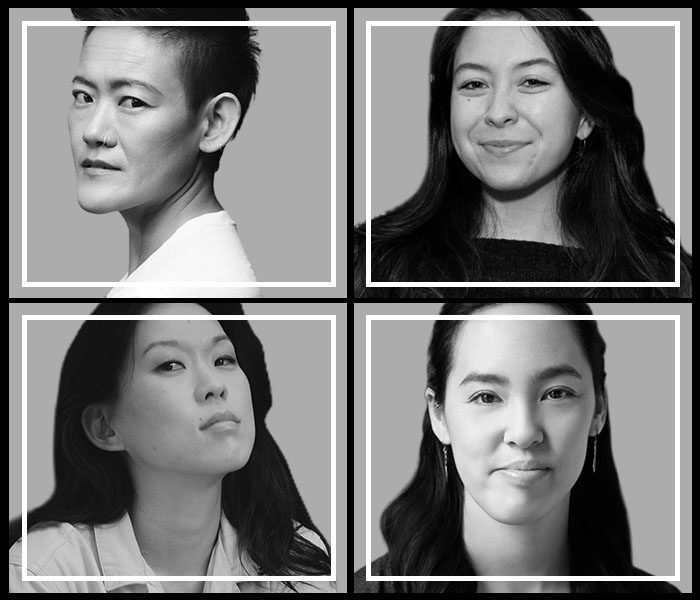
Aya Ogawa, Alex Lin, Jeena Yi and Lauren Yee all have new plays opening Off Broadway. They’re excited and anxious.
—
2020 was shaping up to be the year of the Asian American playwright in New York City. Then COVID-19 hit and all the productions shut down—most before they even opened. After six painfully turbulent years for the theatre industry and its artists, there’s a welcome feeling of déjà vu this month as four new plays by Asian American women and nonbinary dramatists bow Off Broadway simultaneously.
Although attention must be paid to this milestone moment, it should not be reductive. The plays, like their creators, are diverse in style and subject matter. Lauren Yee’s Mother Russia (February 3 to March 22 at Signature Theatre Company) is a darkly comic take on post-Soviet capitalism as two pals are recruited as spies. Alex Lin’s stinging comedy Chinese Republicans (February 5 to April 5 at Roundabout Theatre Company’s Laura Pels Theatre) centers on three Asian American businesswomen who reckon with what they left behind to get ahead. Writer-director Aya Ogawa’s Meat Suit, or the shitshow of motherhood (February 11 to March 15 presented by Second Stage Theater) is an amusingly unconventional meditation on motherhood. And Jesa (March 10 to April 12 at The Public Theater from troupe in residence Ma-Yi Theater Company) by Jeena Yi—also a busy actor scheduled to appear in the Broadway comedy The Balusters later this season—is a haunting look at volatile sibling relationships.
TDF Stages gathered the playwrights to chat about their shows, using humor to make their messages go down and why they’re both excited and anxious about this breakthrough in representation.
Eileen Rivera: Your plays running concurrently is being hailed as an important occasion. Has that crossed your mind at all as you’ve been working on your respective productions?
Lauren Yee: The last time I was produced in New York, in 2020, there was a similar moment, and it was heralded. I remember during previews of my play Cambodian Rock Band [at Signature Theatre Company], Parasite won the Oscar and it felt like there was this wave of energy. And you know what? Remember that pandemic that happened afterward? Which is to say that, yes, I feel like these moments should be celebrated and I’m so excited for this energy. But at the same time, I’m reminded of how quickly that energy can change, and how rapidly it can go from a celebration to being reminded that we have so much work to do.
Aya Ogawa: I remember that Cambodian Rock Band was one of the last plays that I saw before the pandemic hit. I was directing Haruna Lee’s Suicide Forest, and we had to close down. I remember as well that there were all these Asian playwrights [being produced at the time].
Jeena Yi: I remember Young Jean Lee’s play because it was called We’re Gonna Die. I saw it right before the pandemic, and it stuck with me.
Alex Lin: One of the most exciting parts of this moment for me is that audiences are going to be able to see very different voices from this shared identity group all at once. I think that can do a lot of work dismantling the false narrative that because you belong to an identity group, your plays are in competition with each other, or all the same type of play. The fact that all four of our shows are going up and we have a shared but very different pedagogy because of how we express ourselves as artists, that’s the most powerful thing about it for me. I’m going to try to be as authentic as possible to my artistic message. And I know all of these other artists are going to do the same thing.
Eileen Rivera: Characters grapple with visceral, inherited burdens in all your plays. Are you explicitly writing about intergenerational trauma, or is it simply the context of their lives?
Aya Ogawa: My play isn’t about Asian identity. It’s about motherhood, and about this intergenerational lineage. Some of it is trauma, and some of it is not. I’m acknowledging the “mom” part of my Venn diagram. Especially in theatre, moms are often made invisible; they feel they must hide their personal lives because revealing them might jeopardize their ability to get hired. So, a lot of moms leave the industry. I feel really excited and proud to have this moment to talk about that part of my identity.
Eileen Rivera: Jeena, how about you? Jesa, which centers on four estranged Korean American sisters who reunite in the wake of their father’s death, seems pointedly about intergenerational trauma.
Jeena Yi: I never set out to write a comedy about intergenerational trauma. I really wanted to write about sibling relationships. The question I kept pondering when I was writing this was: How do our parents haunt us in life and in the afterlife? How do they haunt us in our everyday lives and in the ways that we live? At the same time, I like to laugh. I like joy. I really like to embrace laughter, even if there are tears. So yes, there is the intergenerational trauma of it all, which I think is a universal thing. But the bigger thing is, there is something about tragedy that makes you just kind of laugh. I think that’s the delicious little space that I like to play in. I like playing in that space as an actor, and I wrote this play for actors to just fuck around and have fun.
Eileen Rivera: Lauren, your play is about political oppression across generations and how folks can’t seem to get out from under it, no matter how far removed.
Lauren Yee: It falls in line with my preexisting work in that I’m interested in history and how things came to be. Unbeknownst to me, I have been writing a cycle of plays about communism in Asia in the 20th century, decade by decade, and its collision with Western pop culture: Cambodia in the ’70s with rock music [Cambodian Rock Band], China in the ’80s with basketball [The Great Leap] and with Mother Russia, Western capitalism and marketing in post-Soviet Russia in the ’90s. I hadn’t even realized it. I think Mother Russia is a play that is less about two generations, and more about how a young generation might come up in the midst of chaos, with the kind of world that they thought they knew suddenly shifting underneath them, and how funny and terrifying that is.
Eileen Rivera: Alex, in Chinese Republicans, three Asian American businesswomen of a certain age are confronted by an up-and-comer. I love the generational clash over what American success means. What inspired the play?
Alex Lin: Conversations I’ve had within my own family. But because I believe the personal is political, it has an inherently macro lens. In exploring trauma that my family went through, what it actually explores—through a very specific group of women and through personal stories and relationships—is the trauma that I think we all share by living in America, a culture that for 250-odd years has been inherently brutalist, hyper-industrialist, very masculine and modeled after the Roman Empire. I think it’s no mistake that most of our capital buildings are modeled after that type of architecture. The play is exploring what that system does to people with bodies that are not typically seen on an American stage.
Eileen Rivera: In all your plays, you use bold humor to get at painful things: exclusion, isolation, being left behind. How does comedy help you explore these serious issues?
Jeena Yi: I think as human beings we don’t wake up every day and set out to be miserable, you know? I have found more honesty in writing my characters when there’s some comedy. I don’t plan out every single joke. Sometimes the humor naturally comes out the more honest I am. I find when I consume a book or a movie or another play, I’m often the most moved when I laugh, even if it’s after I cry. Sometimes during the most tragic moments of my life, I have burst out laughing because it was so absurd. I think there’s a catharsis in it. I had a voice teacher, Kristin Linklater, may she rest in peace. She said that everyone should laugh and cry two minutes every day just to stay healthy. I do think that there’s something real in that.
Aya Ogawa: I think there’s no way to talk about motherhood without presenting the sheer absurdity of what life becomes. You can be trying to have a very serious conversation at the same time you have someone vomiting on the sofa. You have to be able to hold everything at the same time. I’m realizing while listening to Jeena, the comedy in my show is at the expense of somebody. I’m presenting a mom character who feels so belittled in different situations and inviting people to laugh, which is kind of a mean-spirited thing to do. But I also think that laughter has a heart-opening mechanism to it. You need to go through that portal in order to reach people at a different level, at least for the way my plays work.
Lauren Yee: The yawning abyss of late-stage Western capitalism—what’s not to approach with joy? All my plays delve into really dark subjects. And I think the way, as a writer, to give it that sense of contrast and snap and tension, is through humor. It’s the way that people deal with grief and terror and absurdity, and it’s also a way to bring an audience in. I think when you’re dealing with things like genocide and political structures, it sometimes feels so nutritional. I think disarming people with a laugh, they relax, and then you hit them at the end—my favorite type of theatrical experience. That’s what I love to do.
Alex Lin: My theory about comedy is, if you can tell a joke about something and other people get it, that means you all really understand the idea. I think there are elements of an “idea play” in my play. It deals with ideology that people don’t all agree with. But in writing the play, I really was committed to reasoning out what the root of the ideology is for this hyper-specific group of women. That’s the role that the comedy plays for me. As opposed to just being like: I don’t agree with this, I don’t like it.
Eileen Rivera: When your plays finally meet audiences, what do you hope surprises you?
Alex Lin: Not to get too sentimental, but I hope I’m surprised by how I feel about it. I have a tendency to be like, okay, I did it. I hope I can really appreciate this exciting moment that we’re in.
Jeena Yi: I hope I make it through and don’t get sick.
Lauren Yee: In my plays, there are always a handful of jokes that are just for me—nobody laughs at them except for me. So I’d be delighted if I got one stray laugh for that joke that is just in there for me.
Aya Ogawa: In rehearsals I’ve been feeling this huge resistance toward my own work. So I would love to be surprised by a feeling of openness and warmth once it’s shared with the audience.
Eileen Rivera: And you’ve got that extra layer of being the director, too.
Aya Ogawa: Wish me luck!
This interview has been edited for length and clarity.
—
TDF MEMBERS: At press time, discount tickets were available for Chinese Republicans. Go here to browse our latest discounts for dance, theatre and concerts.