
Three New Plays Shed a Revealing Light on the Dark Side of the Internet

A wave of new Off-Broadway shows zeroes in on online extremism
—
Destabilization, uncertainty and the terror of not knowing: In three new Off-Broadway plays examining online extremism, a search for answers drives isolated, desperate protagonists to the darkest corners of the internet.
In Anne Washburn’s ANON, at MCC Theater through November 1, a disaffected suburban mother is seduced by the online cult of QAnon. Else Went’s Degenerates, at Playwrights Horizons through November 8, focuses on confused young people finding comfort in the vitriol-filled incel community. And for the despondent London teen at the center of Melis Aker’s raucous comedy Fish, at WP Theater through November 1, the only way forward is to send a direct message via Twitter to ISIS.
Equally funny and frightening, these world premieres are a disturbing reminder of the growing power of online hate and conspiracy, forces that have moved out of the shadows and taken hold in mainstream American life.
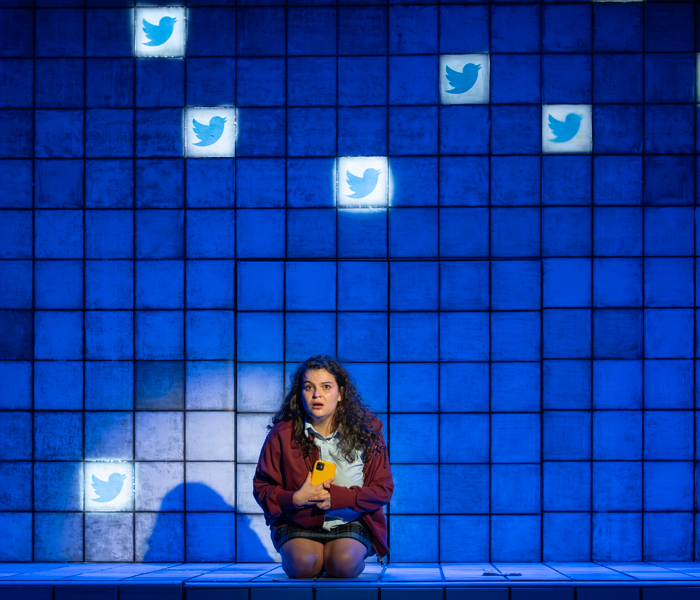
Fish, co-presented by WP Theater and Signature Theatre Company, takes audiences back to a pivotal moment in the evolution of online toxicity. Set in 2016, against the backdrop of a xenophobic Brexit campaign and the proliferation of ISIS beheading videos, the play explores this dark turning point through the prism of Karya, a 17-year-old London girl seeking answers about her brother’s disappearance.
“That year was the beginning of so many different global sweeps of populism,” says Aker, a London- and New York-based playwright who hails from Turkey. “We were losing a sense of self with all the misinformation and learning not to trust what we were ingesting online every day.”
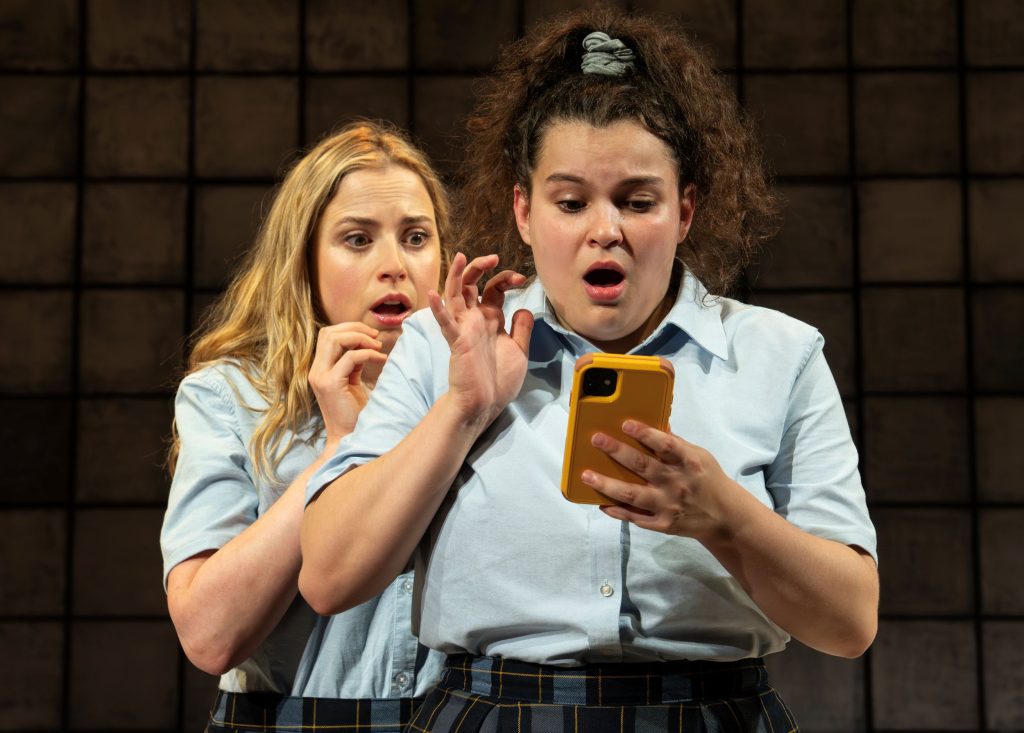
In Fish, Karya (Yasmin Ranz-Lind) and her best friend Libby (Alyssa May Gold) spend their days scrolling, not realizing how the content they’re consuming is affecting their mental state. To them, the parade of online horrors is just another Tuesday.
Then Karya’s mother Ceyda (Roxanna Hope Radja) insists that behind the mask of a new ISIS recruit in a viral video, she recognizes the eyes of her missing son. Ceyda’s belief sends Karya down a dangerous rabbit hole after Libby casually suggests she reach out to ISIS.
“ISIS has social media?” asks Karya incredulously.
“Mate, read the news,” snorts Libby. “They’re like the Kardashians of the Levant.”
Karya’s inquiry sets off a cascading chain of events in Aker’s manic tale, directed by Tatiana Pandiani and produced in association with New Light Theater Project and Noor Theater Company. The curious teen is soon dropped into an ominous world of false identities, online scams and catfishing, failing to grasp the real-world impact of her virtual actions until it’s too late.
“We’re so beyond it now, but that year was the first seed of everything becoming so depersonalized on the internet,” Aker notes. “Today, the core fear remains the same: not being sure what is real, not being sure of the truth.”
Fish is as concerned with the quotidian terrors of teenage life—teacher crushes, irregular periods at school—as with unraveling a possible terrorist conspiracy. Ultimately, Karya and Ceyda are both grappling with insurmountable grief and looking for relief. “It’s not about finding the missing person,” Aker says. “It’s about: what do we need to believe in order to feel safe?”
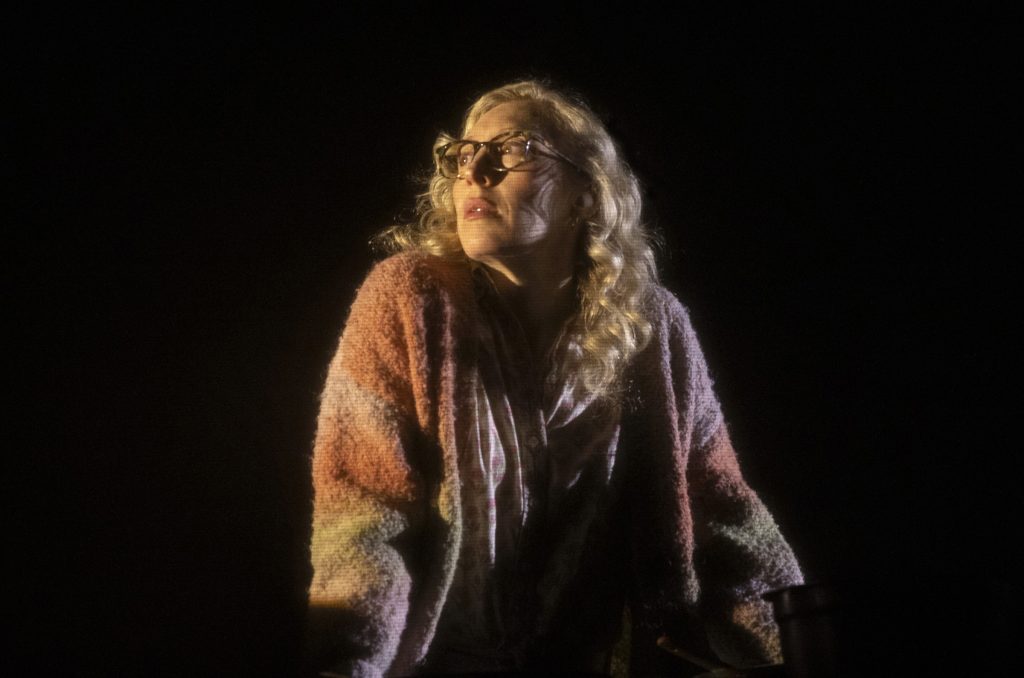
For ANON‘s Jeanie (Crystal Finn), a stay-at-home mom just outside of San Antonio, Texas, her fear and uncertainty are stoked by QAnon. It’s 2024 and faceless fraudsters on the internet have grown hugely in power—instead of scamming teenage girls on Twitter, they’re leading vast online armies against an imaginary cabal of Satan-worshipping, cannibalistic pedophiles.
Washburn, best known for the dystopian masterpiece Mr. Burns, a Post-Electric Play, started writing ANON after witnessing several left-leaning health and nutrition bloggers become part of the conservative, conspiracy-fueled Make America Healthy Again movement spearheaded by Robert F. Kennedy Jr.
“I was watching personalities who I felt I had known on some personal level gradually torque and change,” she says. That made her wonder: “What are the parts of these people’s lives I’m not seeing? The parts they won’t show me, that they may not be able to admit—even to themselves?”
The most frightening disconnect in ANON, directed by Anne Kauffman, is the disparity between Jeanie’s ordinary day-to-day life and her online descent into derangement. In early scenes, Jeanie cooks dinner, keeps house and provides warm, helpful guidance to her daughter Delia (Izabel Mar).
Yet moments later on TikTok, she rants: “For those asking: Why is Fauci still free, when will Hillary Clinton face judgment, where are the arrests, are there medbeds, where is the military? I just want to say, folks: Trust the plan. Trust the plan.”
Key to the appeal of QAnon—for both Jeanie and the playwright—is its epic nature, its promise of a reckoning, a storm that will wash away all the sins of the world. Though the obsession with the fictitious Q himself receded following the 2020 presidential election, for many followers that narrative transformed into a MAGA fixation.
“Humans have always made myths,” Washburn says. “But the online world speeds everything up. And the moment you touch on fear, you touch on myth. The moment you are afraid of someone, it’s very hard to be cooly, calmly reasonable. They bloom into a monster.”
Jeanie’s bogeyman is her new neighbors, the mild-mannered gay couple Will (Jeremy Shamos) and Adam (Jeff Biehl), who put up a Pride flag. They soon discover she’s posting vaguely threatening TikToks about them, complaining about “indoctrination.” Their ensuing battle takes place entirely over social media, technology designed to feed division and distrust. Kauffman’s staging replicates what viewers would see on a TikTok screen, inducing the same hyperfocus and myopia that’s exacerbated by the video platform.
“If they just talked, it would get a lot calmer a lot faster,” notes Washburn about the value of face-to-face conversations. “I don’t think the current political moment would be possible without the internet and what it does to our human brains. We would not have this deeply metastasized division, lies and insano-hostility. Not everybody is QAnon, but we’re all participating in the same environment. We are all damaged.”
The incels of Degenerates are also damaged, but Else Went’s play is surprisingly hopeful about the possibility of rehabilitation.
Out of morbid curiosity, the playwright did a deep dive into incel forums during the early days of the pandemic. She found the self-hatred, misogyny and violence there to be “a form of self-medicating, as one might do with alcohol or drugs,” she recalls. “It’s a self-destructive easing of pain… They are creating linguistic rhetoric to numb their feelings, but it doesn’t actually heal anything.”
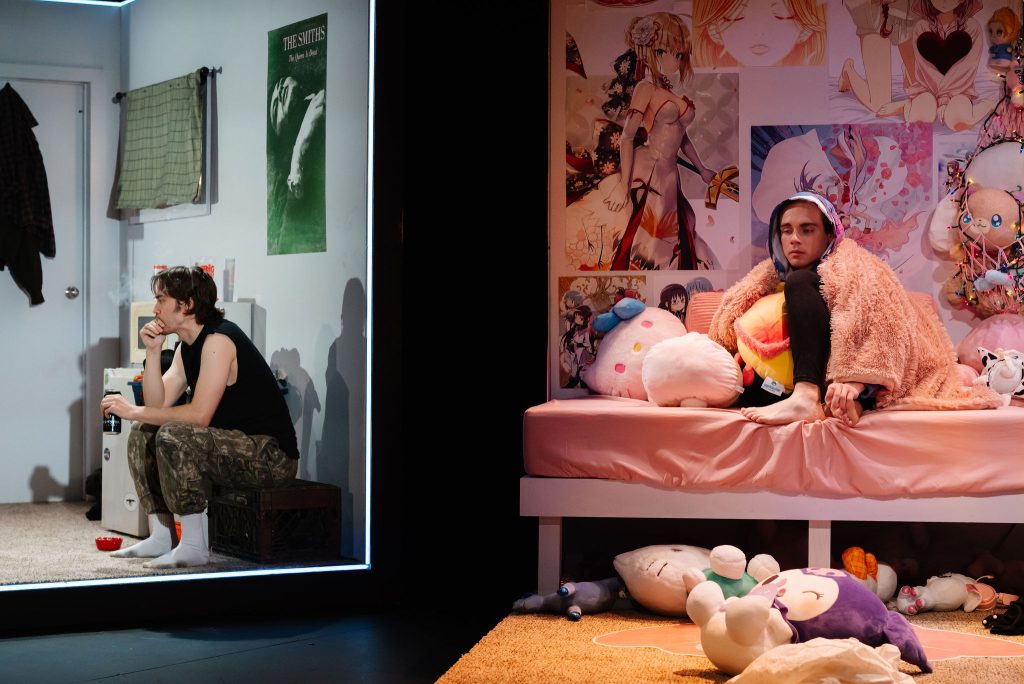
Degenerates traces the surprising connection between two wildly different characters who meet in that sinister void: Miller (Zachary Desmond), the de facto leader of an incel Discord who rails angrily against feminazis; and the comparatively soft-spoken and effeminate Target (Christopher Dylan White), an agoraphobe who identifies as a “mentalcel,” a person who’s involuntarily celibate due to mental illness.
Director Emma Rosa Went, who’s married to the playwright, places Target’s bright, colorful room filled with manga art and massive plushies alongside Miller’s gray, barely furnished apartment, dissimilar yet equally lonely spaces.
What unites the characters, explains Else Went, is a profound discomfort with the traditional expectations of masculinity. “If you are uncomfortable with your masculinity and your gender, it is very easy for people like Miller to supply the wrong answer,” she says.
Over the course of the play’s first act, set entirely in the online world, an unexpected intimacy grows between the two incels that eventually (spoiler alert!) evolves into a romantic bond. Despite all the awful ideas both characters are spouting, you may even start to root for them.
“I expected audiences to have reservations about caring about these types of people,” Else Went says. “That’s why it is so step-by-step as we gradually strip away the shell of those performances.”
While not everyone is saved by the end of Degenerates, the play leans into hope.
“When people are so atomized from community, and most of what they have is online, there’s nothing to hold onto,” Else Went says. “But you only have to grab onto one root hanging out of the cliff in order to catch yourself.”
—
TDF MEMBERS: At press time, discount tickets were available for ANON. Log in to browse our latest discounts for theatre, dance and music.