
Why These Actors Keep Returning to ‘The Weir’ at Irish Rep

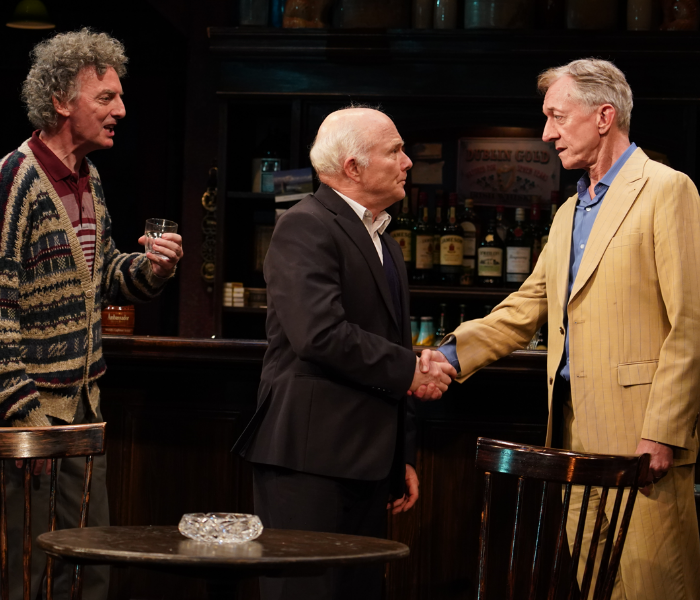
Cast members John Keating, Dan Butler and Sean Gormley and director Ciarán O’Reilly on the hold Conor McPherson’s play has on them—and audiences
—
On a dark evening with a cold wind howling, three regulars at a rural Irish pub spin eerie yarns to impress a woman from the city who recently moved to their village. Turns out she has a chilling ghost story of her own to share—one that will devastate them all. That’s the premise of Conor McPherson’s evocative and poetic The Weir, which the Irish Repertory Theatre is mounting for a third time—four if you include a virtual production streamed during the pandemic shutdown. Tellingly, the same three actors have portrayed the local storytellers in most of these productions over the past dozen years, all under the direction of Ciarán O’Reilly, Irish Rep’s producing director.
Why can’t they get enough of this haunting play? To find out, TDF Stages sat down with O’Reilly and the three returning castmates: Sean Gormley as Finbar, a businessman who’s found success in the city; John Keating as Jim, the local handyman and Dan Butler (who appeared in all but the 2015 revival) as garage owner Jack.
Gerard Raymond: You all clearly have a deep connection to The Weir. Why do you keep coming back to it?
Ciarán O’Reilly: Well, part of it is that it’s set in a place very much like where I grew up. We lived on a farm, but we had a pub in the town—I grew up working there every once in a while. So I recognize all of these people in the play. But it’s also a play that really speaks to humanity. The [characters] respect each other and good-naturedly give each other a hard time, but at the end of the day they hear each other and understand each other. These days it’s a big deal for people to just listen to each other.
Dan Butler: I was surprised how rich the play is—it calls for an investment; it invites you in. As Ciarán said, it’s about community, it’s about stories, it’s about talking.
Sean Gormley: I think for a play that has so much talking in it, there’s an awful lot that’s unsaid. That’s why I find it so appealing. In all the times I’ve done this, I never feel on automatic pilot. I always feel very alert to how everyone else is reacting to it. There’s always somebody saying one thing and maybe meaning another. There’s a lot of layers. And it’s very much reactive to what’s happening in the audience.
John Keating: It’s so interesting, the quietest show I ever remember for this play was the final performance when we did it the first time in 2013. And it was because a lot of the audience were maybe people who had seen it before, and they just wanted to listen to the play. I remember we were a little taken aback at the time by how quiet the audience was, but they were hugely responsive at the end. It was because they were listening to the play and wanted to hear it again. That was amazing to me. I still remember that performance so well.
Gormley: It also matters a lot that it’s happening in real time and there’s no intermission. So you’re seeing a slice of life from a very particular evening.
Raymond: In addition to your production, the playwright is directing a revival of The Weir in Dublin next month that will transfer to London in the fall. What do you think accounts for the play’s enduring popularity? On the surface, not much happens, but it seems to touch audiences very deeply.
Keating: You just sit there, and you’re just taken in by the lives of these people. I think humanity is the word Ciarán used. That’s what you run along with.
O’Reilly: You know, [Irish critic Vivian Mercier infamously said] that Waiting for Godot was “a play in which nothing happens, twice.” I suppose this is a play where nothing happens, maybe four times, with the four different key stories. All of Conor McPherson’s previous plays were monologues and so the Royal Court in London asked him to write something that wasn’t. So he wrote what is basically four monologues with some dialogue in between. You don’t normally see this length of stories in a play.
Butler: I love plays that you can’t categorize.
Raymond: The characters’ stories all have supernatural elements, and death is very much a presence.
O’Reilly: It’s always there. There’s a line at the end of the play: “We’ll all be ghosts soon enough.” It’s like that line in James Joyce’s The Dead: “One by one, they were all becoming shades.” I think it’s omnipresent in Irish culture.
Keating: There’s a huge respect for death, culturally, and I think maybe more generationally.
O’Reilly: You go to a wake not to mourn but to celebrate a lot of the time. I mean, of course you do both, but sitting around a dead body, we tell stories of their life. It’s very Irish.
Keating: There’s an old line in Irish culture that the only difference between an Irish wedding and an Irish funeral is one less drunk!
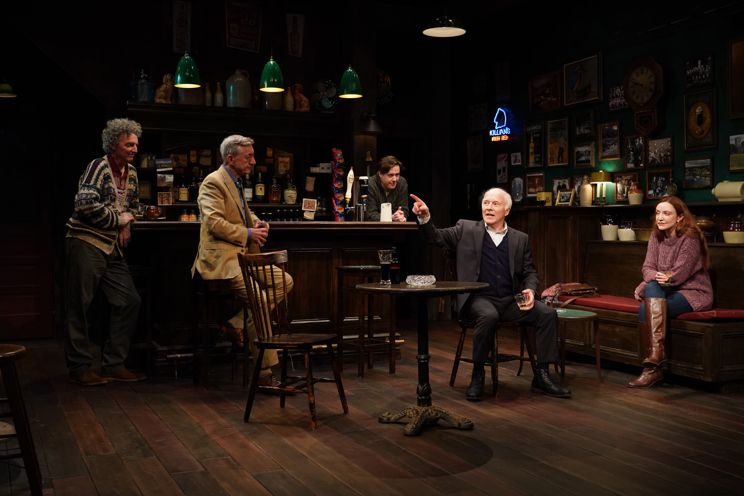
Raymond: The last time you did this play was in 2020 during the shutdown as a virtual production. What do you recall about that experience?
Butler: To me the pandemic turned out to be an incredibly creative time within the constraints of everything, and that was one of the high points. It was like being in our own little prism in that bar—we were in front of green screens in different places all over the country coming together to do this, heartened by the [in-person] experience we had together before.
O’Reilly: It had been seven years since our original production. Just from a purely technical aspect, we basically stuck with the blocking that we had from 2013. But you don’t move at all, you’re right up in front of an iPhone, you know. And sometimes you got it wrong, and the continuity wasn’t there; we had no time to go back and fix it. Somebody would pull a pint in New Jersey and hand it to somebody in North Carolina, and sometimes the glass was the same height when it got there and sometimes not. My favorite one was at the very end when Jack put the jacket on Valerie. He lifted it up in Vermont and she put it on in Connecticut!
Butler: I have very long arms!
Raymond: How do you all feel about returning to the play once again, especially during this fraught time of people not listening to each other?
Keating: It’s just a joy to be back in the bar again. From the first moment I heard we were going to do it again this summer I was excited. Just the idea of hearing everything again—a real joy.
Gormley: The full ensemble hasn’t been the same every time—there’s always somebody different and that changes everything. For this production there’s a new Valerie [Sarah Street] and a new bartender [Johnny Hopkins].
O’Reilly: It was basically us saying let’s look at this and rediscover it all over again. And it’s not just us returning to this play, it’s a lot of people who come and see this play again and again because it’s like visiting a place you know, like a hilltop or a forest or somewhere you’re going to find peace. It doesn’t have to do with being entertained, exactly. It’s more than that. It’s almost like an immersive place where you sit amongst these people. It’s like going to mass.
Butler: It’s great coming back. I love the times when I’m going, “I can’t believe that this did not even cross my mind before” and finally pennies are dropping. The first production was perfect for what it was. And our digital version was perfect for when and what that was. And now our world is different and we’re different, and this is what’s coming out. I just think the whole thing is beautiful. And if there’s any excuse to bring beauty into the world right now, let’s take it!
This interview has been edited for length and clarity.
—
TDF MEMBERS: Go here to browse our latest discounts for dance, theatre and concerts.